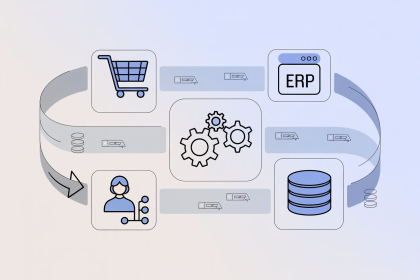
API Integration Definition
API integration is the connection between two or more systems through their APIs, allowing them to exchange data and trigger actions automatically. An API (application programming interface) is the interface a system exposes so others can read or write its data; an API integration is the working link built on top of that interface, so that a change or request in one system produces the right result in another without anyone copying data by hand. For example, an API integration can let a PIM send product information to an online store the moment it is approved.
How does an API integration work?
One system sends a request to another system's API, and the API responds with data or confirms that an action was carried out. To make this reliable, an API integration also handles authentication (proving it has permission to connect), data mapping (matching fields in one system to the equivalent fields in the other), and error handling (catching and retrying failed requests). The exchange can run on a schedule, in batches, or in near real time, depending on how the systems are set up and how quickly the data needs to move.
What is the difference between an API and an API integration?
The two are easy to confuse but distinct. An API is the interface itself, the set of rules a system publishes for how others can interact with it. An API integration is what you build using that interface: the actual, working connection that moves data between systems for a specific purpose. Put simply, the API is the possibility and the integration is the result. A prebuilt connector is one common way to create an API integration without writing custom code, since it packages the authentication and mapping for a particular system in advance.
Why do API integrations matter for product data?
Product information is created, priced, and published across many systems, and API integrations are what keep those systems aligned. When a PIM, an ERP, and a storefront are connected through their APIs, a single update flows automatically to every place that needs it. This removes manual re-entry, keeps data consistent across channels, and shortens the time it takes to launch or change products. Because the exchange happens automatically and can run in near real time, API integrations also reduce the delays and errors that come from moving data by hand.