

Product Information Management
AtroPIM brings your product information into one place and keeps it consistent across all channels and languages.
AtroPIM is an open-source Product Information Management system for manufacturers, wholesalers, distributors, and retailers whose product data has outgrown spreadsheets. It replaces scattered article lists, Excel files, and CSV exports with one flexible source of trusted product information. Built on the AtroCore platform, AtroPIM goes beyond traditional PIM: manage product data alongside suppliers, assets, technical documentation, and other business data, while adapting the system as your catalog, markets, and team grow.
How does it work?
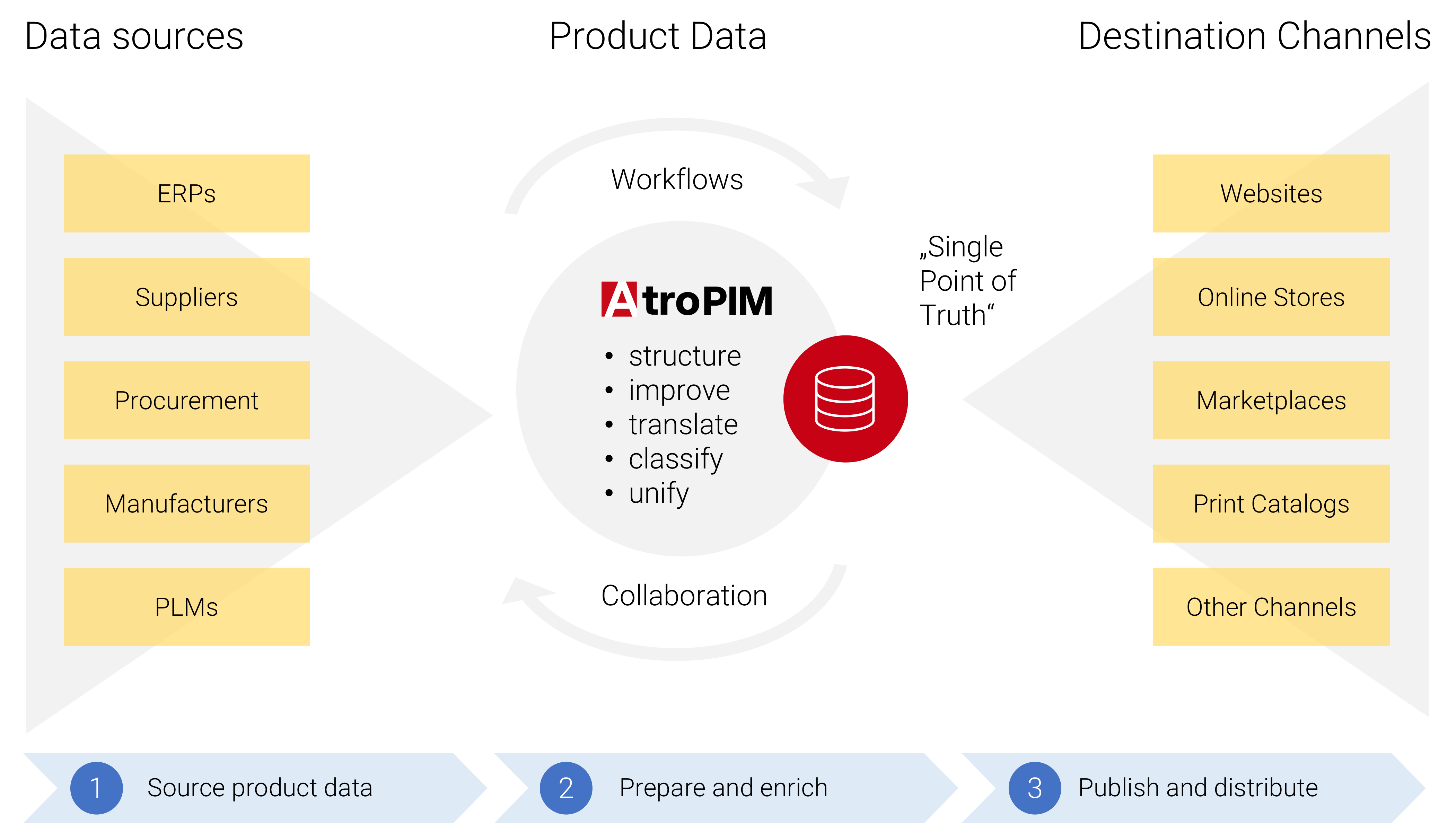
AtroPIM is where your product data is created, not just where it passes through. Data comes in through imports, integrations, or manual entry, and lands in a data model you define rather than one the software imposes. Your team writes descriptions, adds attributes and translations, and enriches records with AI assistance where it helps, while completeness figures show what is still missing. Workflows route records through approval, and approved data goes out to shops, marketplaces, print catalogs, and partner portals in the structure each of them requires.
Feature Highlights
Configurable data model: add entities, fields, and relations directly in the interface, with no coding.
Hierarchies and data inheritance: child records inherit values from their parents, including in your own custom entities.
Flexible attribute management: over 20 data types including nested attributes, grouped, scoped, and reused across entities and records.
Classifications for all entities: assign classification schemes to any entity, with attribute sets following the classification.
Custom relation properties: store data on the link itself, such as a category-specific description of a product.
Customizable interfaces and dashboards: arrange panels, fields, and lists per entity, per role, and per user, and let every user build the views and figures they need.
Validation and auto-fill rules: UI Handlers check entries and prefill or hide fields depending on the values a record holds.
Mobile-friendly user interfaces: the interface adapts to tablets and phones without a separate app.
Customizable record previews using HTML/CSS: design how a record is presented to users and partners.
Product-centric data management: entities, screens, and logic built around products and their data.
Hierarchical product variants: model configurable products and their variants in a parent and child structure.
Product category trees: several independent category structures per catalog, channel, or market.
Channels and channel-specific attributes: different values per sales channel, maintained on one product record.
Bidirectional associations: link records both ways, from upsell and cross-sell to spare parts and accessories.
Product listings and reusable text blocks: curated product selections for catalogs and campaigns, with marketing and legal text placed wherever it is needed.
Localization, units, and currencies: values per language side by side, measurements converted automatically, and amounts maintained per currency.
DAM and file management: store, categorize, and reuse assets, including language and channel-specific versions.
Filtering, saved searches, and bulk editing: build a complex filter once, reuse it across your team, and update hundreds of records or their links in a single step.
Collaboration and notifications: assignments, mentions, and comments stay on the record they belong to, and users hear about the changes that concern their work.
Action buttons and automated workflows: trigger custom operations from a record or a mass selection, and let statuses, approvals, and follow-up steps run on their own.
AI-assisted content: connect Gemini, ChatGPT, or Claude to draft and improve product content in place.
Fine-grained access control: rights defined per team, role, entity, record, and individual field.
Change and action history: every change recorded with user, timestamp, and the old and new value.
Import, export, and synchronization: handle any structure and format through database queries, file transfer, or API requests, with heavy operations queued as monitored background jobs.
What can our software be used for?
AtroPIM is a product information management application built on the AtroCore platform. It holds your product data, keeps it clean, and gets it out to every channel, catalog, and partner that needs it.
Product Data Management
Bring product data from suppliers, ERP exports, and spreadsheets into one place. Fill the gaps, apply your own classification, and translate values per language and market. Completeness figures show you what is still missing before a product goes live.
Data Import & Export
Import from XML, JSON, CSV, and multi-sheet Excel files, whatever your data model looks like. Build an export configuration once, then reuse it as an import feed. Every run is logged, so you can see which rows failed and why.
Product Data Exchange
Deliver catalogs in the formats your industry expects, including BMEcat, ETIM, ECLASS, and GS1. Map your attributes to the standard once and generate the required file on schedule instead of rebuilding it by hand each time.
Integration Platform
Connect ERP, shop systems, and marketplaces through database queries, file transfer, or API calls, in one direction or both. Set what runs nightly and what runs on demand, and see the result of every sync.
Digital Asset Management
Asset management is part of the platform, not a separate product. Store images, videos, and documents alongside your products, or connect existing storage such as SharePoint or Amazon S3. Assets attach to products, categories, and catalogs, and can be shared with customers and partners.
Database Publishing
Generate print-ready PDF catalogs, price lists, flyers, and data sheets straight from your product data, either in AtroPIM or through Adobe InDesign. When a price or a specification changes, you regenerate the document instead of editing the layout again.
Product Data Syndication
Send channel-specific content to each destination, so a marketplace listing, a webshop, and a distributor portal each receive what they require. Values maintained per channel live on the same product record.
Workflow Management
Route products through the steps your team actually uses, from supplier data arriving to approval and release. Assignments, comments, and status changes stay on the record, so nobody has to search their inbox to find out what was agreed.
Advantages of AtroPIM
AtroPIM is a modern system with many advantages - for users, administrators and developers.

100% open source and extensible
As an open-source PIM system, AtroPIM can be customized and extended as required. Thus, every customer request is realizable.

Fast and easy user interface
AtroPIM is fast, intuitively understandable and has a modern and comfortable user interface. You can even use AtroPIM on smartphones as a real app.

Integration with any third-party system thanks to the REST API
Thanks to the REST API, AtroPIM can be connected to any third-party system, both for data import and for the data publishing.

Feature-rich
AtroPIM offers many functions directly from the box to make the management of product data and catalogs very flexible.

Configurable
You can customize the data model of AtroPIM completely to your own needs directly from the admin area.

Web-based
AtroPIM is web-based and thus platform-independent. You don’t need a permanent job.

Role-based permissions at entity and field level
In AtroPIM, you can define any roles and teams and determine their permissions, even at field level.

Low costs and short time-to-market
Thanks to high flexibility and configurability, the solution can be implemented at low cost and in the shortest possible time.
Interested? Please send us a request.