


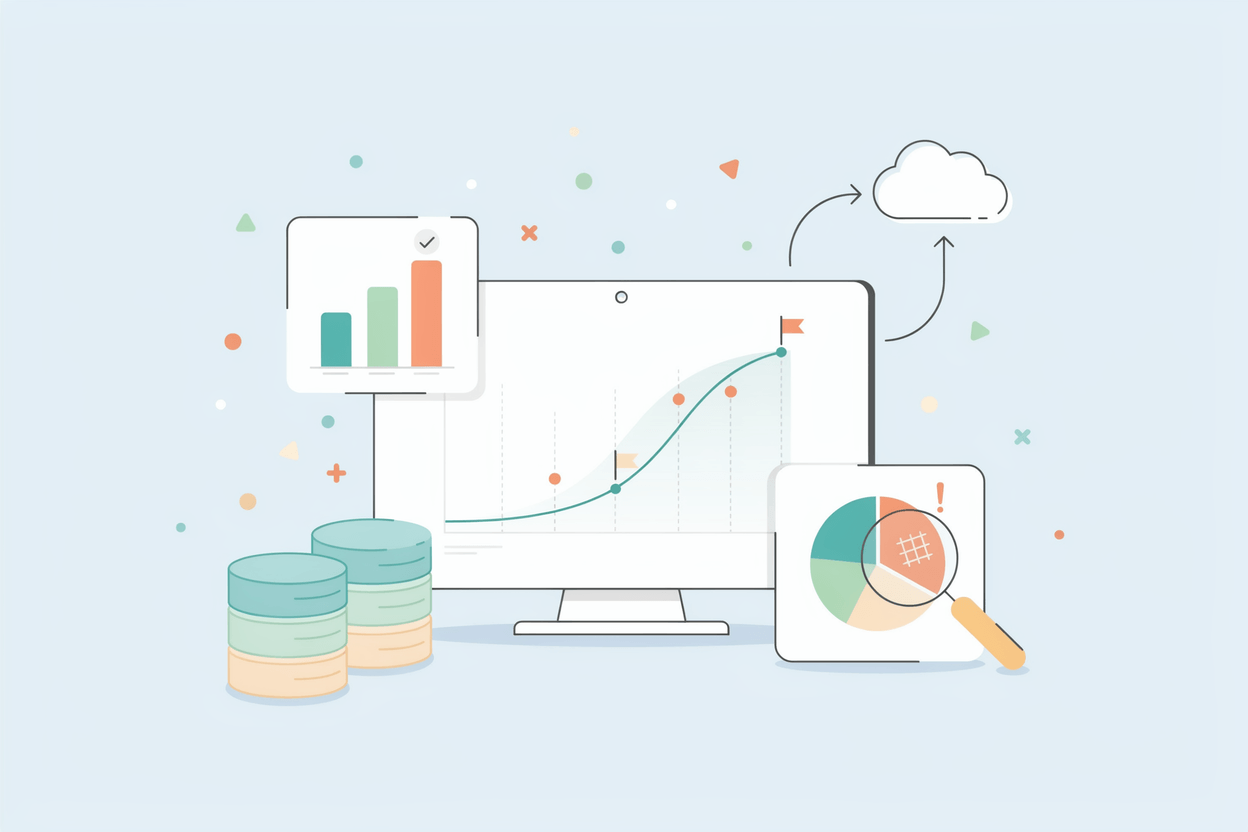
Data doesn't stay clean on its own. It arrives from multiple sources, gets transformed by various systems, and lands in reports, dashboards, or product catalogs that people rely on to make decisions. At every step, something can go wrong: a field goes missing, a format breaks, a value gets duplicated. Data quality monitoring is how you catch those problems before they do real damage.
Gartner estimates poor data quality costs organizations an average of $12.9 million per year. A 2025 IBM Institute for Business Value report found that 43% of chief operations officers identified data quality issues as their most pressing data management challenge. The problem is widespread, the cost is measurable, and it rarely fixes itself without a deliberate monitoring process in place.
What Data Quality Monitoring Actually Is
Data quality monitoring is the practice of continuously measuring whether your data meets defined standards, and alerting you when it doesn't. The key word is continuously. A one-time audit finds problems that existed at a point in time. Monitoring finds data quality issues as they appear, which is the only way to act on them before they propagate downstream.
It differs from data testing, which checks for known, specific issues. Monitoring is broader. It tracks changes in data quality over time, flags anomalies, and gives you a baseline to compare against. When a product attribute field that's normally 98% complete suddenly drops to 60%, monitoring surfaces that. A one-off test wouldn't.
Some teams also encounter the term data observability, which refers to end-to-end visibility into the health of data pipelines: whether data arrived on time, whether schema changed unexpectedly, whether volume looks normal. Data quality monitoring and data observability overlap significantly. Observability tends to focus on pipeline behavior. Quality monitoring focuses on the data itself. In practice, both are needed. Together, they form the operational backbone of any serious data quality management program.
The Dimensions You're Actually Monitoring
Every data quality monitoring program works by measuring data against a set of defined dimensions. The most commonly tracked ones are:
- Completeness. All required fields are populated. For a manufacturer managing thousands of SKUs, a missing weight or hazard classification can block a product from going live on a channel. Null rates and missing values are the standard metrics here.
- Accuracy. The data reflects reality. This is harder to automate because it often requires a reference source or single source of truth to check against.
- Consistency. The same data looks the same across systems. A product described differently in the ERP versus the PIM versus the webshop creates friction at best, errors at worst.
- Timeliness. The data is current enough to be useful. Data freshness failures are common in supplier feeds and any pipeline with a long ingestion lag.
- Validity. The data conforms to defined formats and rules. Schema validation catches this at ingestion. An email address without an @ sign, or a date in the wrong format, is technically present but functionally useless.
- Uniqueness. No duplicate records are creating noise or inconsistency in downstream systems.
In practice, you won't monitor all dimensions equally for all datasets. Identify which dimensions matter most for each data domain and set thresholds accordingly. A data quality score or scorecard that rolls up these dimensions into a single view per domain gives teams and data stewards a practical way to track progress over time and report against data quality KPIs.
What to Monitor and Where
Start with the data that feeds your most critical processes. For manufacturers, that typically means product master data: the attributes, specifications, and classifications that flow into every downstream system. For operational teams, it might be transactional data or customer records.
The monitoring points should map to the places where data can degrade.
At ingestion.
When data arrives from an external source (a supplier, an ERP, a third-party feed), that's where format issues, missing values, and schema changes tend to appear first. Catching them here prevents bad data from entering your environment at all. Data quality checks at ingestion are the cheapest fix in the pipeline. The cost of remediation rises at every subsequent step.
In transformation.
ETL pipelines that move and reshape data can introduce errors: fields dropped, values mapped incorrectly, encoding issues. Monitoring transformation outputs against expected schemas and value ranges catches this category of problems. Data drift (gradual shifts in value distributions over time) is a specific risk here that statistical profiling picks up.
In the master record.
The central record in a PIM, MDM, or master data management system should be checked against completeness rules and business logic before anything is published. A product record with no images and no description shouldn't reach a sales channel regardless of what else looks correct about it.
At distribution.
When data is pushed to a channel, marketplace, or downstream system, a final data validation confirms that what arrived matches what was sent.
Core Techniques
Rule-based validation sets explicit constraints (value ranges, required fields, format patterns, reference checks) and flags any record that violates them. It's deterministic and fast. The limitation is that it only catches what you've already thought to check. A shared business glossary helps here: when rules are tied to agreed definitions, they're easier to maintain and harder to ignore.
Statistical profiling establishes baselines and monitors for drift. If the average length of product descriptions is typically 180 characters and it suddenly drops to 40, that's a signal worth investigating even if no specific rule was broken. Profiling catches the anomalies rule-based validation misses.
Duplicate detection compares records to identify near-matches, not just exact duplicates. Product records with slightly different names but the same EAN, or customer records with transposed characters in a name, require fuzzy matching logic to surface.
Referential integrity checks verify that relationships between datasets hold. A product assigned to a category that no longer exists, or an order linked to a customer record that's been deleted, is an integrity violation that creates downstream problems.
Data lineage tracking documents where data came from and how it was transformed. When a data quality issue appears in a report, lineage lets you trace it back to the source rather than guessing. It also supports root cause analysis: which upstream system introduced the problem, and which downstream systems are affected. A data catalog that captures this lineage makes the tracking operationally useful rather than just theoretical.
Real-time monitoring extends these checks to streaming data environments. Where batch monitoring catches problems at scheduled intervals, real-time monitoring flags issues the moment data enters or moves through the pipeline. For high-velocity data environments, the gap between detection and impact can be very short. Real-time checks reduce that window considerably.
Building a Monitoring Process
Tools don't solve the problem on their own. A few things need to be in place before automated data quality checks add real value.
Defined ownership.
Someone needs to be accountable for data quality in each domain. Without ownership, alerts get ignored, and nothing gets fixed. In larger organizations, this maps to data steward roles. In smaller ones, it's usually the person who owns the system.
Agreed-upon thresholds.
A 95% completeness rate might be fine for a supplementary attribute field and completely unacceptable for a mandatory regulatory attribute. Thresholds should reflect business impact, not just technical defaults. Tie them to data quality KPIs that mean something to the business.
Documented rules.
Every validation rule should have a business rationale attached to it. Rules that nobody can explain tend to get ignored or removed when they trigger inconvenient alerts. Documentation forces clarity about what good looks like, and links data quality standards to data governance policy.
An action path for issues.
Monitoring creates alerts. Alerts need to go somewhere useful: a data quality dashboard that someone checks, a ticketing workflow, a notification to the right person. Monitoring without a clear remediation path, including data cleansing and data validation workflows, just creates noise.
In projects we've supported, a recurring pattern is organizations that invest in monitoring tooling but haven't resolved the ownership question. The system catches problems but nothing gets fixed, because it's unclear whose responsibility it is to act. The problem is organizational, not technical.
Product Data as a Monitoring-Intensive Domain
Product data is worth addressing separately because the volume and velocity of changes is high, and data quality issues are directly visible. A wrong dimension on a technical data sheet, a missing safety classification, an incorrect unit: these reach customers, resellers, and regulatory bodies.
Manufacturers with large catalogs manage records that evolve constantly: new variants, updated specifications, regulatory attribute additions, channel-specific adaptations. Each change is a potential quality event. And unlike a broken internal dashboard, a bad product record gets seen by people outside the organization.
A PIM or MDM system with built-in data quality rules covers much of the rule-based monitoring. But completeness scoring, threshold alerting, and cross-system consistency checks still need configuration that reflects the specific attribute model and channel requirements of the business. Generic out-of-the-box rules rarely align with what a specific manufacturer actually needs.
For teams that need that level of control, AtroCore supports configurable validation rules and completeness scoring at the attribute and entity level. Because it's open-source and modular, data quality checks can integrate into broader data pipelines and connect with external systems rather than sitting in isolation inside the master data software.
Common Failure Modes
A few patterns show up repeatedly when monitoring doesn't deliver.
Monitoring only the datasets you consider "important" creates blind spots. Data quality issues propagate from wherever they originate. Setting thresholds once and never revisiting them leads to alert fatigue or missed issues. Both cause the same outcome: the monitoring gets ignored.
A third failure is purely operational: buying and deploying a tool without configuring it to the actual data model. Default rules catch obvious problems in generic datasets. They miss the domain-specific constraints that matter most, like a required certification field for regulated products or a mandatory image attribute before a record goes live. A monitoring program built on defaults is better than nothing, but not by much.
The most common failure, though, is treating data quality monitoring as a technical project rather than a data management discipline. If the people who act on alerts don't understand what they mean or why they matter, the monitoring infrastructure just generates reports that nobody reads. Data quality assurance only works when technical outputs connect to business accountability.
Where Automation Fits
Automation handles volume. A product catalog with 50,000 SKUs cannot be manually validated at the attribute level. The same applies to any high-volume data environment. Automated data quality checks running continuously across pipelines are the only practical way to maintain data reliability at scale.
What automation doesn't do well is judgment. When an alert fires, a person still needs to evaluate whether it's a genuine problem, a false positive, or a signal that the rule itself needs updating. Automation narrows the set of things requiring human attention. It doesn't eliminate that need.
AI-assisted anomaly detection extends coverage by surfacing unexpected patterns without predefined rules. It works best as a complement to rule-based monitoring, since false positives are common and the logic isn't always transparent. Most teams benefit from layering both: rule-based checks for known constraints, statistical or ML-based monitoring for drift and unknown degradation patterns.
Getting Started
The practical starting point is narrower than most teams expect. Rather than attempting to monitor everything at once, pick one data domain and work through this sequence:
- Define what good looks like. Identify required fields, acceptable value ranges, format standards, and any cross-system consistency rules that apply. This is the foundation of your data quality framework for that domain.
- Set measurable thresholds for each quality dimension. Tie them to business consequences, not technical preferences.
- Assign ownership. One data steward or team per domain, with a clear mandate to act on alerts.
- Instrument the data quality checks. Rule-based validation and schema validation first, statistical profiling once baselines exist.
- Build the remediation path. Decide where alerts go, who reviews them, and how data cleansing and fixes get tracked.
- Review and adjust. After the first month, revisit threshold settings. Some will be too sensitive; others too loose.
Expand to additional domains once the process works at small scale. A data quality monitoring program that covers one domain well is more useful than one that covers everything poorly.