


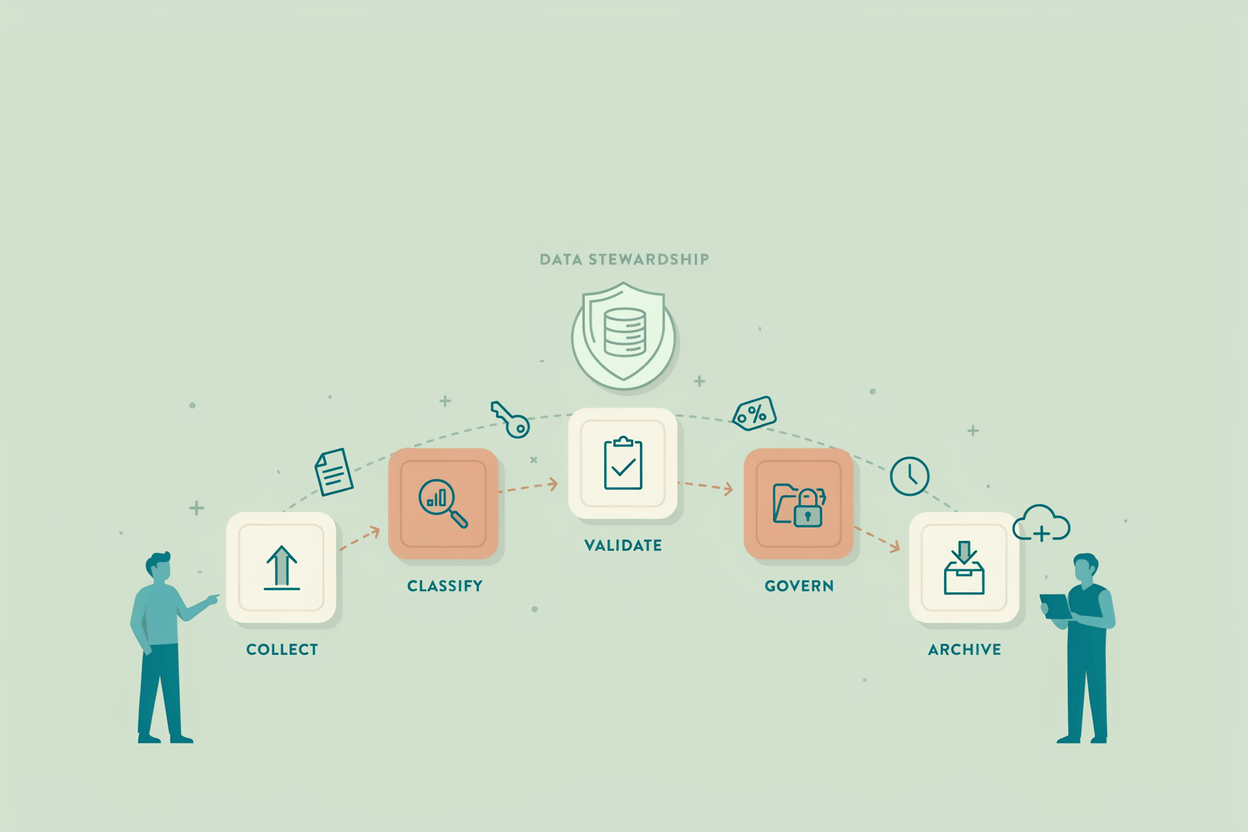
A data steward ensures an organization's data is accurate, consistent, and used correctly. The role sits inside a broader data governance program and is responsible for the day-to-day work of making governance policies real.
The title exists because governance documents don't enforce themselves. A policy that defines how product data should be structured, classified, and shared across systems is only useful if someone actively maintains it. That is what a data steward does.
What Is a Data Steward?
A data steward is a person or team responsible for the quality, integrity, accessibility, and appropriate use of an organization's data assets within a defined domain. Their work covers data accuracy, data consistency, and data completeness: the three properties that determine whether enterprise data is actually usable. Data integrity sits across all three. It is the condition where data remains correct, unaltered, and trustworthy from the point of creation through every system it passes through. The domain could be product data, customer data, supplier data, financial data, or any other data category critical to the business.
The role is sometimes full-time and dedicated. More often, stewardship responsibilities are distributed across people who also hold other titles: data analysts, product managers, category managers, or operations leads. What matters is the accountability, not the job title.
Data stewardship sits inside data governance but focuses on execution. Governance defines the rules. Stewardship applies them.
Types of Data Stewards
Organizations typically define stewardship roles at different levels, and in practice, the boundaries between them overlap.
Business Data Stewards
Business data stewards own the meaning and usage of data within a specific business function or data domain. They define what a product record should contain, which fields are mandatory, and what valid values look like. They contribute to data policies and procedures that govern how data is created, modified, and shared. They work closely with the business users who create and consume data and serve as the primary point of contact when data standards need to change.
Technical Data Stewards
Technical data stewards handle the physical layer: data models, database schemas, data integration mappings, and data pipeline definitions. They ensure that how data is stored and moved matches what the business steward has defined. When a business requirement calls for a new attribute or a change to a data classification standard, the technical steward translates that into a system change.
Process Data Stewards
Process data stewards focus on data as it moves through end-to-end workflows. They manage the handoffs across systems, look for where data degrades as it passes between platforms, and enforce data standards at integration points. This type is the one most likely to catch inconsistencies that neither the business steward nor the technical steward sees independently.
In projects we have implemented for manufacturers dealing with complex product catalogs, all three types were needed. A business steward defined what a chemical product record must contain to meet regulatory requirements. A technical steward ensured the ERP exported that data correctly. A process steward tracked what happened to it when it reached the e-commerce platform. A field mapping error was silently dropping hazard classification values on every sync.
Core Responsibilities
Maintaining Data Quality
The primary job of a data steward is to ensure that data is fit for purpose. That means defining data quality rules, running regular audits, flagging records that fail validation, and tracking the remediation of errors. In more mature programs, stewards also run data profiling to assess the baseline state of new data assets before they enter a governed workflow.
In projects we have implemented for industrial equipment manufacturers, product data quality issues were the first thing that broke down after catalog growth. A company with 40,000 SKUs and ten product managers updating records had no consistent validation layer. Attribute values were inconsistent across product families. Mandatory fields were left empty. The data steward role was the missing link: one person per product category, accountable for quality, armed with a clear set of rules and the ability to enforce them through the system.
Managing Metadata and Data Lineage
Metadata management is one of the steward's core functions. It covers maintaining the data dictionary, glossaries, field definitions, data lineage records, and data catalog entries that make data assets discoverable and interpretable. Without it, different teams use the same terms to mean different things, and integrations fail at the semantic level rather than the technical one. A well-maintained data dictionary also supports data discovery, letting analysts find and understand data assets without asking someone who built the system three years ago.
Data lineage is especially important in multi-system environments. When a product attribute has a different value in the ERP than in the e-commerce platform, the steward needs to trace where the divergence started. Without a documented lineage, that investigation can take days.
Enforcing Governance Policies
Stewards implement access controls, data classification standards, and data lifecycle rules defined by the governance program. They establish data procedures for how records are created, modified, reviewed, and retired. They manage data access so that sensitive data reaches only authorized roles, and run data monitoring to catch policy violations or quality degradation before they compound. This also covers data sharing governance: defining which data assets can be shared with which external systems or partners, and under what conditions.
They make sure records are classified correctly, that sensitive fields are protected, and that data retention policies are followed. Data security and data privacy run through this work. Enforcing data standards consistently across domains ensures that a "supplier" record in one system means the same thing as in another.
Regulatory compliance runs through this responsibility as well. GDPR, for instance, requires that personal data be accurately maintained and accessible only to authorized roles. The data steward is the person who ensures those requirements are reflected in how data is actually stored and accessed, not just stated in a policy document.
Resolving Data Issues
When data problems surface, the steward investigates the root cause, coordinates with the teams involved, and owns the fix. This often includes data cleansing to correct invalid records and data deduplication to resolve conflicting entries across systems. It is often more time-consuming than it sounds. A product record with missing hazard classification data might trace back to a supplier onboarding process that never asked for it, a template that didn't include the field, and a data import that stripped the value during format conversion.
Bridging Business and Technical Teams
Data stewards translate between the people who use data and the people who manage the systems that store it. Business users describe what they need data to do. Technical teams describe what the system can do. The steward's job is to find where those requirements align and flag where they conflict. In organizations without a dedicated data owner at the executive level, the steward often absorbs this coordination role by default.
Challenges Data Stewards Face
The role is operationally demanding, and the challenges are consistent across industries.
Data scattered across too many systems. Most mid-sized companies manage product, customer, and supplier data across an ERP, a CRM, an e-commerce platform, and spreadsheets. The steward has no single view. They work across disconnected systems with different data models, export formats, and update cycles. The same master data record can exist in five places with five slightly different values.
No clear data ownership above the steward level. Stewardship works when it's part of a functioning governance structure with executive backing. When it isn't, the steward lacks the authority to enforce policies on teams that resist changes to how they enter or maintain data. The policies exist on paper. The steward can flag violations. But without escalation paths and organizational buy-in, the issues recur.
Volume and velocity. Gartner research puts the average annual cost of poor data quality at $12.9 million per organization. That figure reflects how widespread the problem is, not how easy it is to fix. A steward managing tens of thousands of records across multiple data domains cannot do effective quality work manually. The work requires tooling.
Regulatory complexity. GDPR, CCPA, and industry-specific regulations add compliance requirements that the steward has to translate into concrete data handling rules. These rules change. New regulations arrive. Existing ones get reinterpreted. Keeping data practices current is ongoing work, not a one-time project.
Resistance to process change. Getting product managers or sales teams to follow new data entry standards is a change management problem, not a data problem. Data stewards spend a large portion of their time on communication, documentation, and training rather than purely technical work.
What Makes Stewardship Work
Stewardship succeeds when two structural conditions are met: clear domain ownership backed by executive authority, and tooling that supports governance workflows at the volume the organization actually operates at. Without both, a data stewardship program stays reactive. Stewards fix issues after they surface rather than preventing them.
A data-driven organization needs stewardship to function as a proactive practice, not a cleanup operation. That requires the right people, the right mandate, and tools that surface data quality issues automatically rather than waiting for a downstream system failure to reveal them.
The tooling question matters more as data volume grows. A data steward managing a few hundred records can work with spreadsheets and shared documentation. One managing master data across product, supplier, and customer domains in a company with tens of thousands of SKUs needs a platform that centralizes records, enforces validation rules, tracks data lineage, and supports approval workflows. Without it, the steward spends most of their time on coordination and remediation instead of governance.
This is where master data management platforms become relevant. A centralized MDM platform gives stewards a single place to define data models, set quality rules, manage access controls, and monitor compliance. Instead of chasing data across disconnected systems, they work from a unified hub where each data domain has a clear owner, a defined data standard, and a single authoritative record. MDM practitioners call this the golden record.
AtroCore is an open-source MDM and system integration platform that covers this ground. It supports configurable data models across domains, role-based access control, built-in validation and approval workflows, and real-time synchronization with ERP, CRM, and e-commerce systems. Data stewards use it to manage the full data lifecycle for enterprise data: from initial ingestion and data enrichment through to quality monitoring, classification, and distribution to connected systems. Quality rules are enforced at the point of data entry, change history is logged automatically, and cross-system consistency is maintained through bidirectional sync rather than periodic exports.
Our customers often come to us with a stewardship problem that looks like a technical problem: data inconsistencies between their ERP and their product catalog portal. In most cases, the inconsistency exists because there is no authoritative source. Once master data is centralized in AtroCore, the steward has one record to govern, and downstream systems pull from it. The data quality problem shrinks because the architecture stops competing systems from diverging.
The Role Is Expanding
Data stewardship started as a data governance concept in large enterprises with dedicated data management teams. It's now relevant to any organization managing large volumes of structured data across multiple systems, which increasingly includes mid-sized manufacturers, distributors, and B2B companies that have grown their digital operations faster than their data practices.
The gap shows up in predictable ways: product data that means one thing in the ERP and another in the webshop, supplier records duplicated across systems with no data custodian to consolidate them, and compliance fields left empty because no one was accountable for them. These are stewardship failures, not technology failures.
The numbers explain why the role matters. A 2025 IBM Institute for Business Value report found that over a quarter of organizations estimate they lose more than $5 million annually due to poor data quality. The data steward role exists to close that gap. It won't close it alone, but without someone accountable for data quality on a daily basis, governance programs remain aspirational rather than operational.