


Data quality problems cost money. Gartner estimates that poor data quality costs the average enterprise $12.9 to $15 million per year. A 2025 IBM Institute for Business Value study found that 43% of chief operations officers ranked data quality issues as their most significant data priority, with over a quarter of organizations losing more than $5 million annually, and 7% reporting losses above $25 million.
Most of those losses are preventable. Data validation is one of the most direct ways to prevent them.
What Is Data Validation?
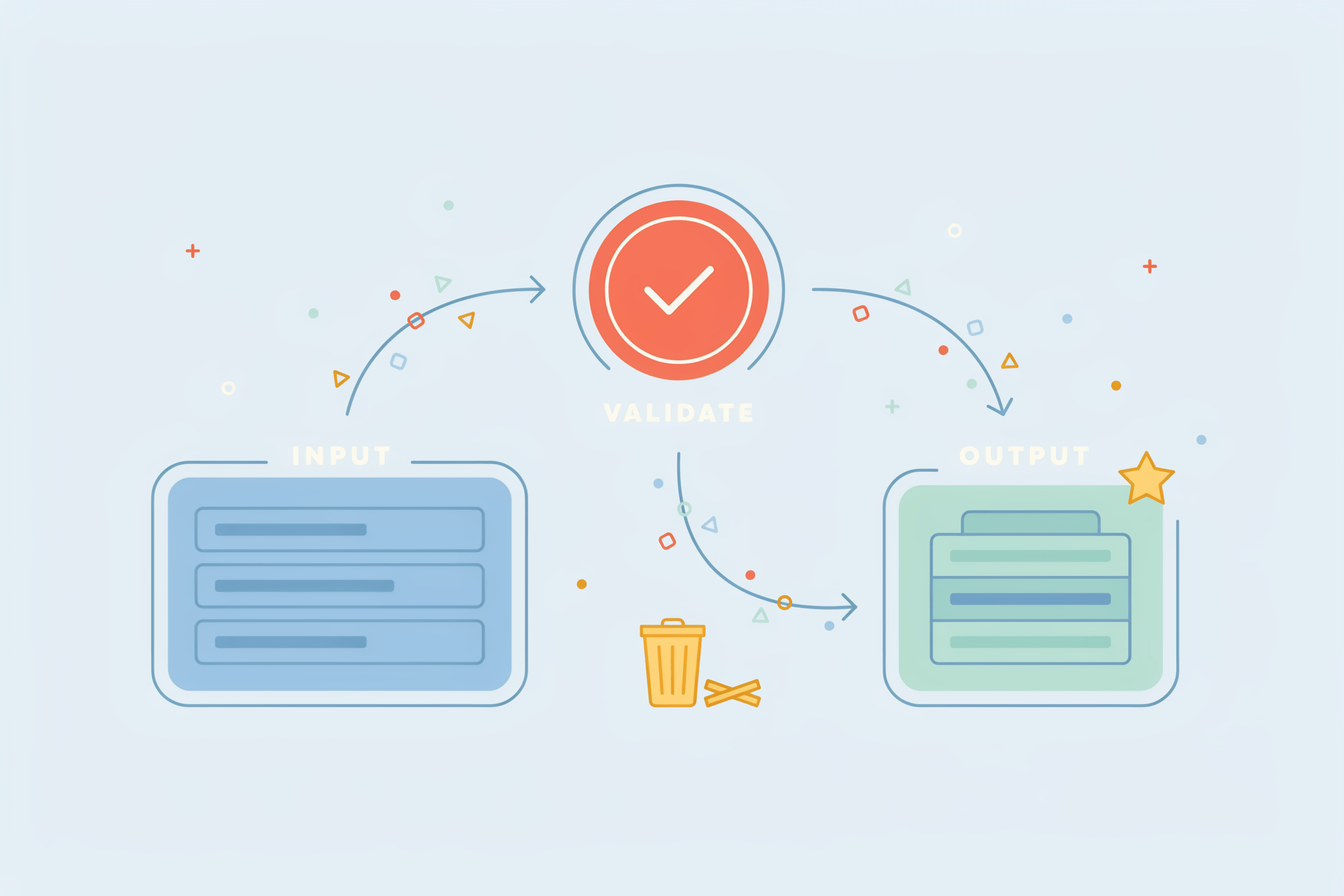
Data validation is the process of checking data against a defined set of rules before it gets stored, processed, or used. The goal is to confirm that data is accurate, complete, correctly formatted, and logically consistent before anything downstream relies on it.
Think of it as a quality checkpoint built into your data pipeline. A form that rejects a phone number with letters in it. A system that flags a shipping date set before the order date. A database that won't accept a product price of -$40. Each of these is a data validation rule at work.
Data validation does not guarantee that the data is true. It guarantees that data is structurally and logically acceptable. A person can enter the wrong phone number in exactly the right format, and validation will pass it.
That distinction matters. Validation catches format errors, missing values, out-of-range numbers, and logical impossibilities. It does not catch intentional misinformation or facts that happen to fit the expected pattern. For that, you need data verification, a separate but complementary process.
Data Validation vs. Data Verification vs. Data Quality
These three terms are closely related and often confused.
Data validation confirms that incoming data meets predefined rules and structural criteria. It happens at or near the point of data entry or ingestion, before data reaches core systems.
Data verification goes further: it confirms that validated data corresponds to real-world truth by cross-checking it against external or authoritative sources. A phone number that passes validation contains digits in the right format. A phone number that passes verification actually belongs to the person it's attributed to.
Data quality is the broader concept. It covers accuracy, completeness, consistency, timeliness, and uniqueness across all data in a system, not just at the point of entry. Data validation is a primary mechanism for enforcing data quality, but data quality management also includes ongoing monitoring, data cleansing, deduplication, and data governance processes.
Validation stops bad data from entering. Verification confirms the data reflects reality. Data quality management keeps both in check over time.
Data Quality Dimensions That Validation Addresses
Each standard data quality dimension maps to specific validation check types.
Accuracy and completeness are the two most immediately actionable. Accuracy is served by type checks, range checks, and format validation — they catch values that are structurally wrong before any deeper verification is needed. Completeness is enforced by presence checks, which reject records with missing mandatory fields. An order without a delivery address fails completeness. So does a product record without a price.
Consistency is handled by checks that span multiple fields within a record, catching logical contradictions like a return date that precedes a purchase date. It also applies at the system level: cross-system checks during data integration or migration flag the same record appearing in conflicting states across different databases.
Uniqueness is enforced by checks that flag records sharing values that should be distinct, such as customer IDs, invoice numbers, or product codes. Duplicates are especially common during imports and migrations, where the same record can be ingested more than once from overlapping source systems.
Timeliness can be addressed by rejecting records with dates outside an acceptable range or by flagging records that have not been updated within a required period. It is the dimension most often overlooked at the validation design stage and the one that tends to surface as a compliance issue later.
Types of Data Validation
The most common data validation checks address a predictable set of failure modes. Most validation frameworks combine several of these.
Data type validation confirms that the value in a field matches the expected data type. A numeric field should not contain letters. A date field should not contain free text. Type validation prevents errors that break calculations and database queries entirely.
Format validation confirms that data follows a specified pattern. A date in a YYYY-MM-DD field must look like a date. An email address must include a local part, an @ symbol, and a valid domain. Format validation is especially important for data imported from external sources, where formatting conventions often differ from your own system's expectations.
Range validation confirms that numeric values fall within acceptable limits. An age field should not accept values above 150 or below 0. Range checks catch obvious errors before they distort reports and analyses.
Presence validation (also called a completeness check) confirms that required fields are not empty or null. Records with missing mandatory fields are rejected or flagged at the point of entry.
Consistency validation looks across multiple fields within a record to catch logical contradictions. A delivery date before the order date. An employee's start date is after their termination date. The individual field values may each look valid in isolation, but together they describe something impossible.
Referential integrity validation confirms that relationships between data tables are valid. If an order record references a customer ID, that customer ID must actually exist in the customer table. Broken references create orphaned records that surface as reporting errors and application failures.
Schema validation checks that incoming data conforms to a predefined structure: the right field names, the right data types, and the required fields all present. It is the first line of defense when receiving data from external sources or integrating systems with different data models. A supplier feed that drops a required column or renames a field fails schema validation before any other checks run.
Business rule validation enforces organization-specific logic that goes beyond structural correctness. A credit limit that must not be exceeded in a transaction. A discount that requires manager approval above a certain value. Business rules are where validation becomes context-specific, and they require ongoing maintenance as requirements evolve.
Where Data Validation Happens in the Data Lifecycle
Data validation is not a single step. It applies at multiple points as data moves through a system, and the cost of catching errors differs significantly depending on where in the lifecycle the check runs.
At the point of entry, validation runs as users fill out forms or upload files. Errors are flagged immediately, so the user can correct the problem before anything reaches a database. This is the cheapest point to catch errors. Input validation at this stage also reduces the need for data cleansing later, which is a substantially more resource-intensive process.
At the point of integration, when data moves between systems or is ingested from external sources, validation checks confirm that incoming data meets the target system's requirements. This is especially relevant during data migration projects and ETL (extract, transform, load) processes, where data from multiple source systems must conform to a unified schema and set of business rules. ETL validation catches mismatches before they corrupt the target database: inconsistent date formats, missing required attributes, out-of-range values that looked acceptable in the source system but violate rules in the target.
Post-processing validation checks data that already exists in systems. It finds errors that were entered before validation rules were in place, or that slipped through earlier checks. This is the most expensive validation to run because it involves finding and correcting problems after the fact. But it is still far better than discovering them during a compliance audit or after a business decision has been made on flawed data.
In projects we have seen, the most persistent data quality problems originate at integration points. A manufacturer importing product data from suppliers regularly receives records where numeric fields contain descriptive text ("N/A", "TBD", "see spec sheet"), date fields use inconsistent regional formats, and required attributes are missing entirely. Enforcing schema validation and data type checks at the point of import, alongside a clear data specification for incoming feeds, resolves the majority of these issues before they reach any downstream system.
Data Validation Rules: How to Define Them
Validation rules are the core of any data validation process. A rule defines what acceptable data looks like for a given field, record, or dataset. Good rules are specific and tied to business requirements.
"This field must contain a valid email address" is a rule. "This date must fall within the last 12 months" is a rule. Each rule should be documented in plain language alongside its technical implementation, so business stakeholders can review it without reading code.
Rules must be defined based on what data should look like, not on what the existing data happens to contain. A common mistake is to profile existing data first and write rules to match it, which locks errors in rather than removing them. Define the requirements first, then validate both new and existing data against them.
Rules also need ownership. A data owner, data steward, or data governance team must be responsible for maintaining each rule as business requirements change. A pricing field with a maximum value set several years ago may no longer reflect current realities. Validation rules that are never reviewed become a liability rather than a safeguard.
Data Validation and Regulatory Compliance
Regulatory risk is real here, and data validation is part of managing it.
Under GDPR, organizations processing personal data of EU residents are required to maintain data accuracy and to correct inaccurate data when requested. Under CCPA, as amended by the CPRA in 2023, California residents have the explicit right to correct inaccurate personal information that businesses hold about them. Validation at the point of data entry and during integration reduces the volume of inaccurate records that reach production systems, directly supporting both obligations.
GDPR fines can reach up to 4% of global annual revenue or €20 million, whichever is higher — neither figure includes reputational damage or litigation costs.
CCPA intentional violations carry fines of $7,500 per violation. Organizations subject to HIPAA, PCI-DSS, or SOX face similar requirements to maintain accurate, complete, and auditable data. Data validation is a necessary component of any data governance framework that takes these obligations seriously.
Automated Data Validation vs. Manual Validation
Manual validation works on a small scale. A team can review a few hundred imported records and catch many errors. At larger data volumes it becomes impractical, inconsistent, and slow, and it is exactly at larger volumes, that the cost of data errors is highest.
Automated data validation runs validation rules consistently, at speed, without fatigue. It catches the same classes of errors every time, logs failures for review, and integrates into existing data pipelines. Most modern data management, ETL, and master data management (MDM platforms include built-in validation capabilities. Purpose-built data quality tools can enforce complex business rules across large datasets and track validation failure rates over time.
Research on workflow automation finds that error rates for repetitive administrative work can drop by up to 75% once automated validation and processing rules are in place. The gains are real, but they depend on the rules being well-defined to begin with.
Automation is not a complete substitute for human judgment. Automated systems are good at catching expected error types and poor at identifying contextual inconsistencies or plausible-but-wrong values. Setting rules too strictly blocks legitimate data. Setting them too permissively lets errors through. Calibrating rules well requires expertise in both the data domain and the business context.
The practical approach is to automate routine checks and use human review for rule definition, edge cases, and periodic audits of whether the rules are still fit for purpose.
Common Data Validation Mistakes
Most data validation failures are process problems, not technical ones.
The most damaging is defining rules too late. Validation rules written after data has already been collected often reflect the existing data rather than the correct requirements. This locks errors in rather than removing them. The right sequence is to define what data should look like, then collect it.
Miscalibrated rules are the next most common problem. Rules that are too strict block legitimate data: an email validation rule that rejects unusual but valid domain formats, or a name field that rejects special characters, will fail on a significant portion of real-world records. Rules that are too permissive catch nothing useful. A format check that accepts near-anything, or a range check set too wide, creates a false sense of confidence while errors pass through unchecked.
Rules without ownership degrade silently. If nobody is responsible for reviewing a rule when business logic changes, it will eventually become wrong without anyone noticing. Data sources change. Thresholds shift. Products are renamed. Validation rules need a named owner and a review cadence.
Relying on entry-point validation alone is also a common gap.
Data degrades over time regardless of how clean it was when it arrived. Addresses become incorrect. Contacts change jobs.
Ongoing data quality monitoring is needed to catch problems that appear after data enters the system, not just at the moment it does.
How to Implement Data Validation
Data validation is a sustained process.
Start by defining data requirements before writing any rules. Identify what accurate, complete, and correctly formatted data looks like for each field, based on business requirements rather than on what currently exists in the database.
Validate as early in the data lifecycle as possible. Errors caught at the point of entry cost a fraction of what they cost to correct after processing, migration, or use in business decisions. Build input validation into forms and data ingestion pipelines before anything else.
Document every validation rule in plain language. A rule that exists only in code is invisible to the business stakeholders who need to review and maintain it. Documentation also makes audits substantially easier.
Assign data ownership explicitly. Every dataset and every validation rule needs a named person or team responsible for keeping it current. Without ownership, rules drift out of alignment with reality.
Monitor validation outcomes continuously. Track error rates by field and by data source. A spike in validation failures from a specific supplier or integration point is a reliable signal that something has changed upstream and needs attention.
Build rule reviews into your data governance calendar. Tie them to business requirement changes and to regular governance cycles, so that rules stay current rather than becoming a historical artifact.
The goal is not a perfect system that catches every possible error. The goal is a systematic process that catches the most common and most costly errors reliably, and that makes the remaining problems visible enough to address before they cause damage.
Data Validation and AI
Data quality validation has always mattered. It matters more now.
Gartner predicts that through 2026, organizations will abandon 60% of AI projects that are not supported by AI-ready, validated, high-quality data. That figure is not abstract. IBM research describes a retail company that deployed an AI scheduling tool across more than 6,000 stores, only to find that managers manually overrode 84% of the AI-generated shift schedules. The root cause was inaccurate training data on worker shifts. The model learned the wrong patterns because the data it was trained on was wrong.
Bad training data does not produce a weak AI model. It produces a confidently wrong one.
A model trained on inaccurate or inconsistently formatted data learns the wrong patterns. An automated workflow fed bad input data produces bad output. The "garbage in, garbage out" principle applies at every stage of a data pipeline, but it applies most damagingly at the AI and machine learning layer, where errors compound at scale and can be difficult to trace back to their source.
Organizations that have invested in sound data validation practices and data governance frameworks before scaling AI will be better positioned than those retrofitting data quality after the fact. Clean, validated data produces more reliable models and more defensible decisions.
Data validation does not solve all data quality problems. But it removes a large, predictable category of them before they propagate.