


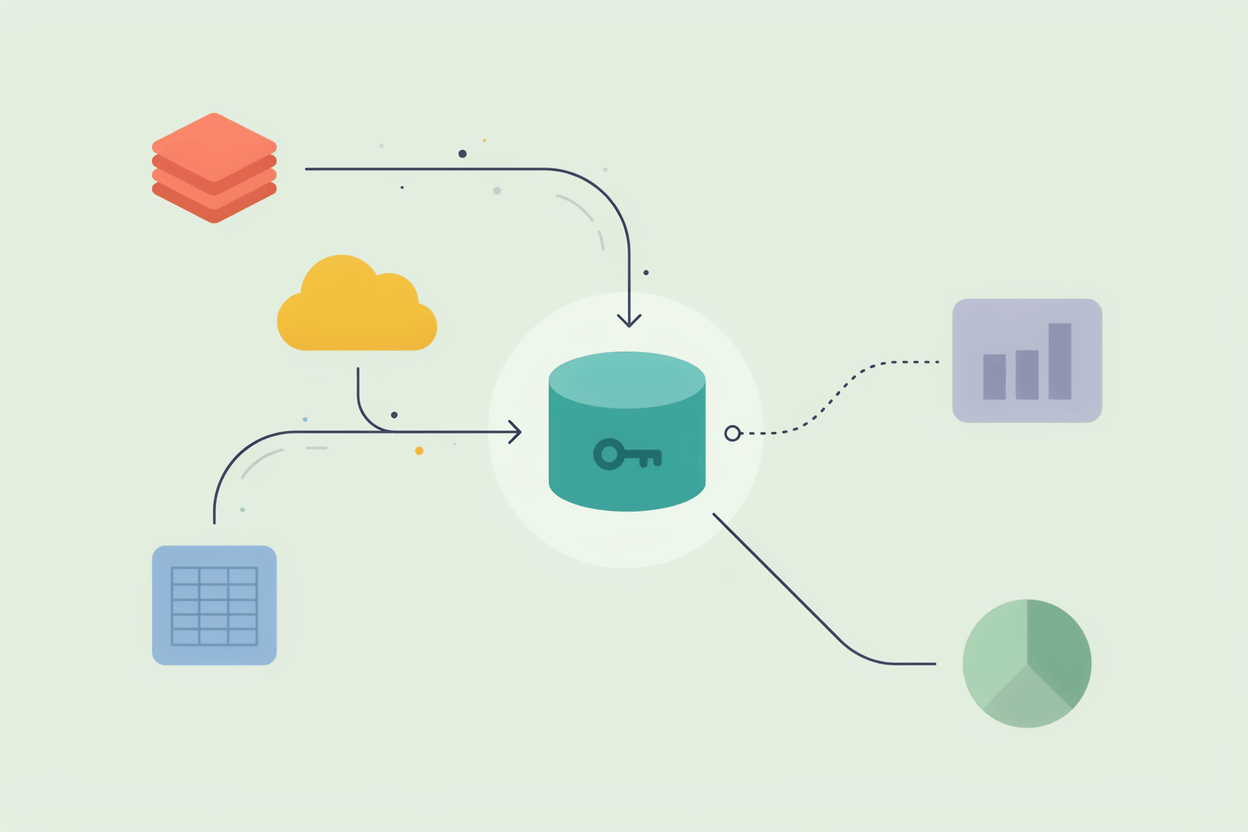
When a business report shows numbers nobody can explain, someone spends hours tracing data back through pipelines, transformations, and integrations. That process is manual, slow, and error-prone. Data lineage software automates it.
At its core, data lineage software maps the complete path your data takes: where it originates, how it changes through each data transformation, which systems it passes through, and where it ends up. The result is a documented, often visual, record of data movement across your entire architecture. When something breaks or a regulator asks questions, you have an audit trail.
What Data Lineage Software Does
The term "lineage" covers several distinct capabilities. Tools differ considerably in how deeply they implement each one.
Pipeline mapping is the baseline. The software scans your connected systems, identifies data sources and destinations, and draws a lineage visualization of how data flows between them. Good tools do this automatically through automated discovery and keep the map current as your architecture changes. Manual documentation goes stale within weeks in any environment where pipelines are actively developed.
Column-level lineage goes deeper than table- or dataset-level tracking. The tool follows individual fields through every data transformation step. If the customer_id field in your marketing report is populated from three different source systems via two ETL jobs, column-level lineage shows you that chain from origin to consumption. Table-level tracking alone often cannot isolate where a specific value went wrong.
Business lineage vs. technical lineage is a distinction worth understanding early. Technical lineage tracks the exact code-level data flow: SQL queries, dbt models, ETL jobs, stored procedures. Business lineage abstracts that into terms non-technical users can read, showing how a KPI in a finance report connects back to a source system without exposing the underlying logic. Enterprise tools often provide both views. Which one your team needs depends on who is using the lineage data and for what.
Impact analysis works in the opposite direction of tracing origins. You want to change a field, rename a table, or deprecate a data source. The tool shows the downstream data dependencies: which reports, dashboards, pipelines, or processes will break if that data dependency changes. Without it, even routine schema changes carry disproportionate risk.
Metadata tracking and audit trails record what changed, when, and by whom. For data stewards working in regulated environments, this documentation is not optional. It is what makes compliance reporting possible without months of manual reconstruction.
Why Organizations Implement It
Teams arrive at data lineage software through a few specific pain points, rarely as a proactive architecture decision.
Broken pipelines are the most common trigger. A report shows inconsistent numbers and nobody can explain why. The investigation involves manually checking source systems, ETL logic, transformation logic, and intermediate tables. In complex environments, this can take days. Data lineage tools reduce mean time to resolution (MTTR) by letting engineers trace the exact data path and identify where an error was introduced rather than checking every system manually.
Regulatory pressure is a close second. GDPR, CCPA, HIPAA, and BCBS 239 all require organizations to demonstrate how personal and financial data is collected, stored, and processed. Reconstructing that documentation manually at audit time is expensive and unreliable. Lineage tools maintain a continuous audit log as a byproduct of normal operations rather than a separate documentation effort.
System migration is where the absence of lineage becomes most expensive. Moving from an on-premise warehouse to a cloud data warehouse like Snowflake or Databricks, consolidating ERPs, or switching ETL platforms requires a complete map of data dependencies before any change. Teams that attempt migrations without that map routinely underestimate scope, break downstream consumers, and extend project timelines by months.
In projects we implemented for industrial equipment distributors managing product, supplier, and customer data across PIM, ERP, and e-commerce systems, the recurring problem was that nobody had a reliable map of what fed what. Errors in product pricing and stock data would surface in the shop but trace back to a data transformation applied three systems upstream. Building that map cut the time to isolate data quality incidents from half a day to under an hour.
The cost of poor data quality is real and well documented. Gartner estimated poor data quality costs the average enterprise $12.9 million per year. Data lineage does not solve data quality on its own, but it is the prerequisite for fixing quality issues systematically rather than one incident at a time.
Types of Tools
The market splits into four categories, each with real trade-offs worth understanding before you shortlist.
Open-source tools like Apache Atlas, OpenLineage, and Marquez give you flexibility and no licensing cost. The trade-off is implementation and maintenance effort. These tools work well for organizations with strong data engineering teams and specific requirements that commercial tools do not cover. Apache Atlas is widely used in Hadoop-based environments. OpenLineage is worth noting because it is an open standard rather than a product: it defines how lineage events are emitted, and tools like dbt, Airflow, and Spark can emit OpenLineage-compatible events natively, making it a useful common integration layer across a modern data stack.
Most large enterprises land on a commercial data catalog or governance platform. Collibra, Informatica, Alation, MANTA, Atlan, and Microsoft Purview all include lineage as part of a broader data governance product, with vendor support, wider native integrations, and interfaces built for both data engineers and business users like data stewards and compliance officers. Collibra dominates in organizations that need end-to-end lineage alongside policy enforcement and governance workflows. MANTA specializes in deep cross-platform impact analysis through advanced code parsing, including legacy systems that others handle poorly. Atlan positions itself as an active metadata platform that makes lineage queryable rather than a static diagram.
Data observability platforms like Monte Carlo and Acceldata take a monitoring-first approach. They track data freshness, volume, and schema changes in real time and layer lineage on top to support root cause analysis. These tools suit teams whose primary concern is pipeline reliability rather than governance compliance.
If your lineage problem stems from master data fragmentation across systems with no single source of truth, a standalone lineage tool maps the chaos but does not reduce it. AtroCore is an open-source master data management and integration platform that centralizes master data for product, customer, and supplier domains across all connected systems. Because all master data flows through one controlled hub with a full REST API, bidirectional synchronization, and a complete entity change history, tracing data provenance becomes answerable at the platform level without a separate lineage layer. For manufacturers and distributors with fragmented system landscapes, that architectural consolidation often delivers more durable results than layering a data lineage software tool on top of an unresolved master data problem.
How to Choose
The decision depends less on which tool has the most features and more on what your team will actually use and maintain.
Start with your data stack. A tool with gaps in your core systems will require custom connectors or workarounds that add permanent maintenance burden. Get a confirmed list of native integrations for each shortlisted tool and compare it against your real architecture. Pay particular attention to whether coverage extends to on-premise databases and legacy systems, which many cloud-native tools handle poorly, and whether the tool connects to your specific cloud data warehouse, BI layer, and transformation tools like dbt.
Then consider who needs to use the lineage data. If the primary use case is compliance reporting, users are data stewards and compliance officers who need clear lineage visualization and governance workflows. If the primary use case is debugging data pipelines, engineers need granular column-level lineage, fast data discovery, and direct access to transformation logic. Most tools optimize for one audience more than the other.
Open-source tools offer flexibility but require your team to own the implementation, upgrades, and integrations. Commercial tools reduce that burden but introduce licensing costs and vendor lock-in. Neither is inherently better; the right answer depends on your team's capacity and what your governance requirements actually are.
Evaluate total cost of ownership rather than license cost alone. An open-source tool with no licensing fee may require considerable engineering time to deploy, maintain, and extend. A commercial product with a high annual fee may pay for itself in reduced engineering overhead and faster incident resolution within a year.
One question worth asking every vendor: how does data mapping stay current as your pipelines change? An accurate lineage visualization at deployment becomes misleading within months if updates require manual intervention. Confirm whether the tool updates automatically through native integrations or whether someone has to trigger refreshes.
Data Lineage and AI Governance
AI introduces a new dimension to the lineage argument. When a model produces an unexpected result, the first questions concern data provenance: where did the training data come from, was it processed consistently between model training and inference, and can you prove it? Without lineage, those questions are hard to answer and harder to document for external review.
Regulatory frameworks are moving in this direction. The EU AI Act requires organizations deploying high-risk AI systems to document the data used for training, which is a lineage problem in practice. Forrester's 2023 Data Culture and Literacy Survey found that over a quarter of organizations dealing with poor data quality estimate losses exceeding $5 million annually, with the risk growing as AI adoption expands. AI compliance without documented data provenance is not compliance.
Teams building AI applications on production data should establish end-to-end lineage for training and inference datasets before scaling model deployment. The specific artifacts that matter are: the version and origin of each training dataset, the transformation steps applied before features reach the model, and whether the input schema at inference time matches what the model was trained on. A lineage gap at any of those points is where AI incidents typically originate. Lineage tools work best here when combined with data quality monitoring and policy enforcement rather than as a standalone layer.
The Case for Getting This Right Early
Data lineage is rarely felt as urgent until something goes wrong. A failed audit, a production data incident that takes three days to trace, or a data warehouse migration that breaks twenty downstream reports makes the gap expensive and visible.
By the time an organization retrofits lineage onto an existing architecture, the engineering work is considerably harder. Pipelines were not instrumented to emit lineage events, transformation logic lives in undocumented SQL, and source-to-destination data mapping was never written down. Building lineage documentation retroactively often costs more than implementing it proactively would have.
The tools are mature and the entry points are varied. Whether you start with an open-source data catalog integrated into your existing stack, a commercial governance platform, or an MDM architecture that addresses fragmentation at the source, the work compounds. Every pipeline you instrument now is one you will not have to reconstruct under pressure later.