


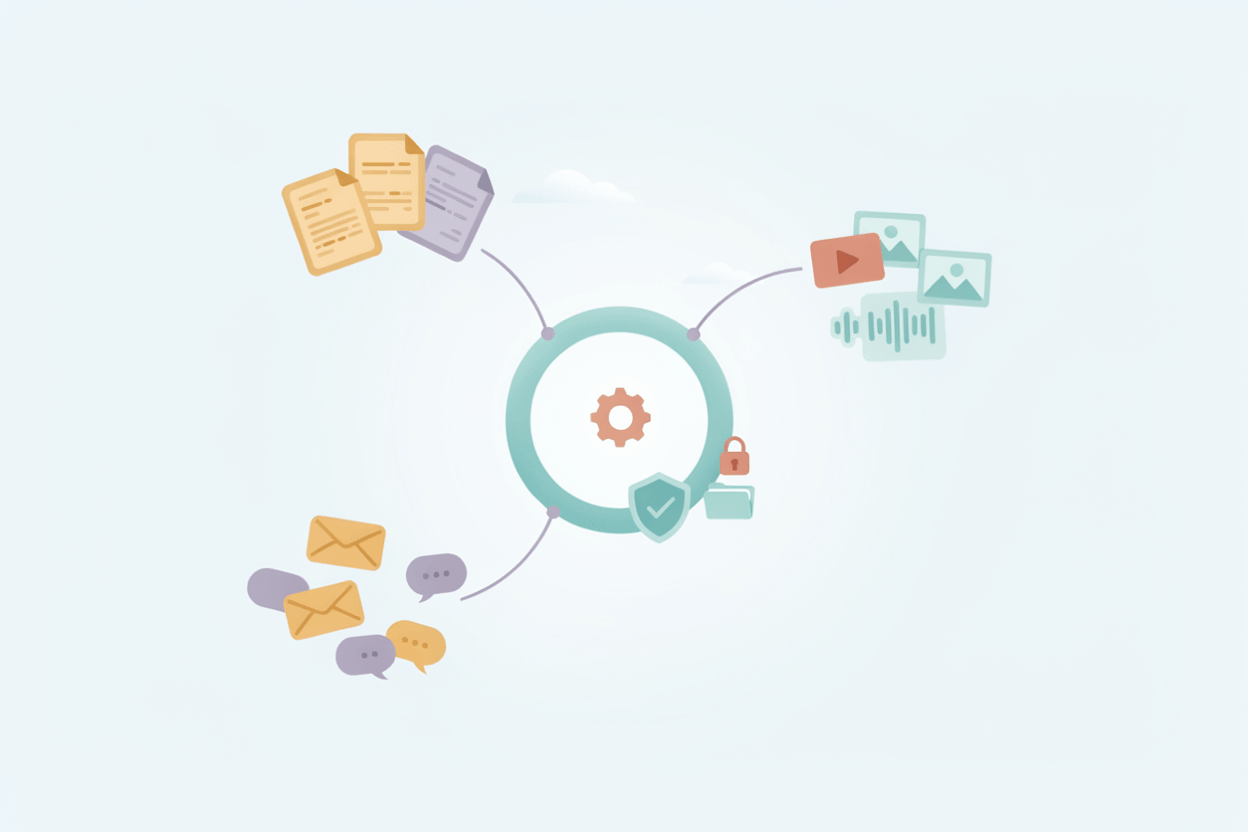
"Unstructured data governance" gets sold as a single discipline with a single playbook. It is not. The phrase covers at least four problems that share almost nothing beyond the file format they live in. Each has a different owner, different economics, and a different tool, and the tools do not integrate cleanly. The most expensive mistake in this space is buying one category of software and expecting it to cover the rest.
You already know the structured-governance skeleton: inventory, ownership, metadata, access, retention. Porting it to files is necessary and it is not the hard part. The hard part is that unstructured data breaks three assumptions the skeleton quietly depends on.
What Makes It Different From Structured Governance
Classification is probabilistic and it costs real money. Every file you want to label sensitive, or a record, or safe-to-delete, is a model call or a human judgment, and the accuracy is never free. So uniform rigor across petabytes is not a strategy, it is a budget line that never closes.
Govern the slice that carries risk or value as if your job depends on it. Put a blanket policy over the rest and let it age out.
The discipline is triage. Programs that try to classify everything to the same standard stall on the arithmetic, every time.
Unstructured data also has no natural steward. Structured data inherits an owner from the system that produces it. A shared drive is produced by everyone and owned by no one, so "assign an owner" is glib until you fix the assignment rule. Two rules hold up: own the data by the business process that generates it, or own it by the master entity it describes. Whatever both rules miss is orphaned, and orphaned data should default to deletion rather than indefinite retention.
Then there is metadata, which rarely exists at the moment of creation. The real question is who pays to produce it, and there are three answers with very different cost profiles:
- Extraction. Cheap and immediate, with accuracy that swings by content type. Good enough for triage, not for a legal hold.
- Inheritance from context. A file takes its metadata from the record or process it attaches to. Cheap and accurate, but only where the link exists.
- Manual tagging. Accurate and expensive, so reserve it for the high-value slice and nothing else.
Inheritance is the underrated one, and it is why binding unstructured assets to structured records pays back far beyond search.
Problem One: Cold Storage Sprawl
Files land on primary storage and never leave. Most go cold within a year and keep consuming flash and backup capacity anyway. The cost here is the storage bill and its backup multiplier, not compliance. Governance means ROT deletion, tiering by last access, and retention that fires on its own. This is a job for storage analytics and lifecycle tiering. An MDM platform or a catalog does nothing for it.
Problem Two: Ungoverned Exposure
Sensitive content sits in files nobody tracks, and now those files feed AI tools. This stopped being a tidiness problem the moment RAG pipelines and employee chatbots began pulling ungoverned files into model context and output. The 2026 IBM figures make the shift concrete. Shadow AI now appears in 43% of security incidents, roughly double the year before, and more than two-thirds of breached organizations had no policy governing AI use at all. IBM sponsors that research and sells the controls it recommends, so read the numbers with that in view. The direction is not in dispute.
Classification has to happen before content reaches the model. A policy engine cannot block a customer record from an unapproved chatbot if nothing ever labeled it a customer record.
Governance here means discovery, sensitivity classification, and enforcement at the point where content leaves for an AI tool or an external channel. This is a job for data security posture management and data loss prevention. It is not MDM either.
Problem Three: AI Findability And Trust
Even when files are safe to use, a RAG system is only as good as the corpus it retrieves from. Duplicate versions, stale documents, and missing lineage produce confident wrong answers, and confident wrong answers are worse than none. The task is curation: dedupe, mark the authoritative version, attach lineage, and run it as a pipeline instead of a one-time cleanup that decays the week after you finish. This is a job for catalogs, indexing, and curation tooling, with real overlap into both storage analytics and master data depending on where the authoritative version actually lives.
Problem Four: Drift Against Master Records
This is the operational problem, and it is the one most data teams get measured on. Unstructured assets that describe governed business entities drift out of sync with the structured record. A product datasheet, its images, and its spec PDF describe a part that also lives in the ERP and the PIM. The part changes, the assets do not, and wrong information ships to channels. In a regulated category that is a compliance event, not an inconvenience.
The cost is rework and error, and it recurs every time the master record changes. Governance means binding each asset to its master entity so the asset inherits identity, versioning, access rules, and retention from the record it belongs to. This is a job for MDM and DAM.
Matching Tools To Problems
No product spans these four. The mapping, roughly:
- Cold storage sprawl: storage analytics and tiering, for example Komprise and storage-native lifecycle tools.
- Ungoverned exposure: DSPM and DLP, with classification at the egress.
- AI findability and trust: catalogs, indexing, and curation pipelines.
- Drift against master records: MDM and DAM platforms.
AtroCore sits in the last row and only there. As an open-source data management and DAM platform, it fits where unstructured assets have to stay consistent with structured master records, product content, supplier documents, or contracts tied to a vendor entity, because its configurable data model lets an asset inherit identity and rules from the record it describes. That inheritance is the metadata advantage from earlier, made operational.
It is the wrong tool for the other three. It will not find and tier cold files at petabyte scale, it is not a posture or DLP layer for shadow-AI exposure, and it is not a retrieval index for a RAG corpus. A team whose real problem is storage cost or AI data leakage should not shortlist it, and any vendor who tells you otherwise is selling past your problem.
Where To Start
Name your actual problem before you name a tool. Most teams have all four but feel only one acutely this quarter. Pick that one, match it to its category, and govern the high-value slice hard while a blanket policy carries the rest.
Build the link to master records early regardless of which problem is biting. It is the single investment that pays back across all four, because it is where findability, consistency, and inherited metadata all come from at once.