


Key Takeaways
- A unified customer data platform pulls customer data from every system into one persistent profile that your other tools can read.
- The core job is identity resolution: recognizing that the website visitor, the email subscriber, and the in-store buyer are the same person.
- Clean, joined-up data pays off in personalization, service, and reporting. Treat the headline percentages as directional, not promises.
- Solutions range from large marketing suites to warehouse-native tools to open-source data platforms. The right one depends on your data structure, not your brand preference.
Most companies already hold everything they need to know about a customer. The problem is where it sits. A name in the CRM, an order in the ERP, a ticket in the help desk, a browsing session in the analytics tool. Each system is right about its own slice and blind to the rest. A unified customer data platform fixes the where.
What A Unified Customer Data Platform Is
A customer data platform, or CDP, is software that builds one persistent customer database and makes it available to your other systems. The word "unified" carries the weight. It merges records from many sources into a single profile per person or company, then keeps that profile current as new data arrives.
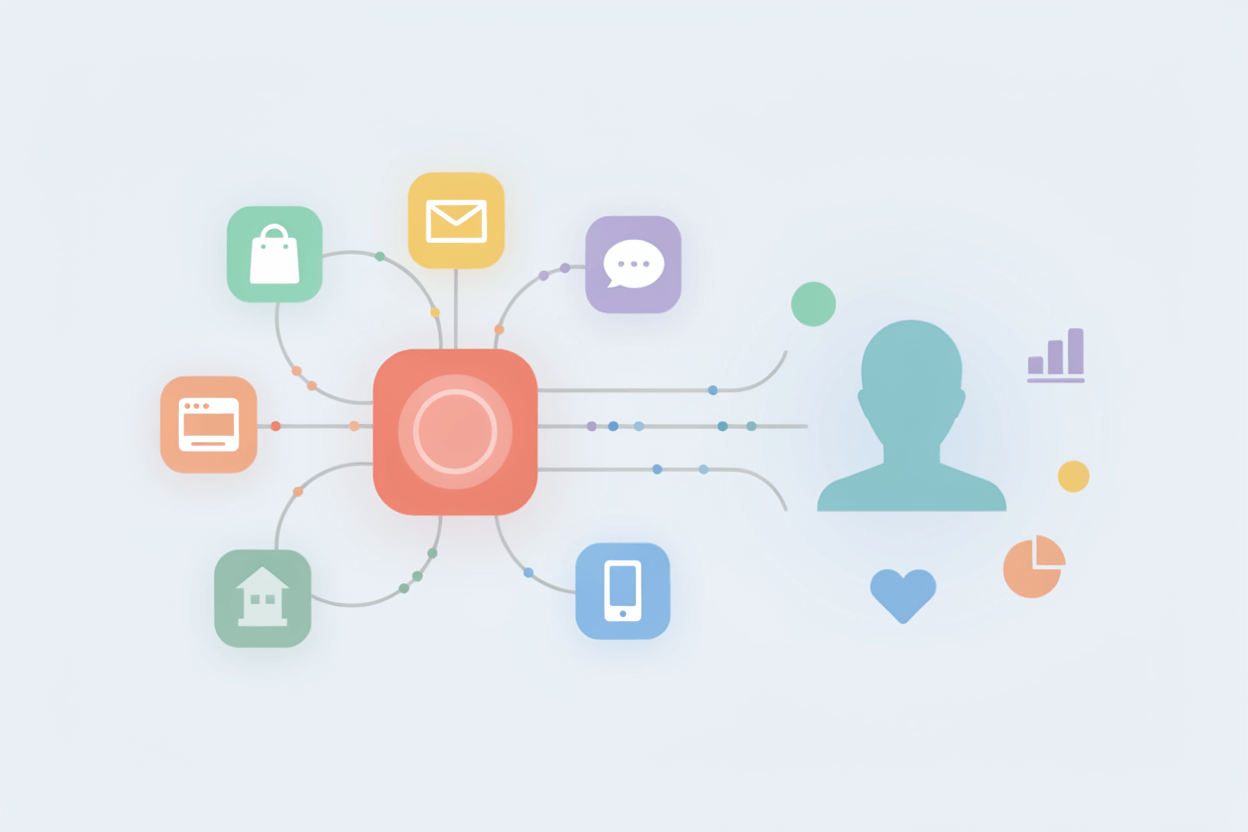
A CDP is not a CRM, and it is not a data warehouse. A CRM records what your teams do with a customer: the calls, the deals, the tickets. A warehouse stores everything for analysts to query later. A CDP sits between them. It collects from both, resolves the mess into one profile, and pushes that profile back out to the tools that act on it.
That last part matters. A warehouse holds data for people who write queries. A CDP is built so a marketer, a service rep, or an automated workflow can use the profile without asking a data engineer first.
Why Scattered Data Costs You
The damage from fragmentation is quiet and constant. Validity's 2025 survey of 602 CRM users found that 76 percent believe less than half of their CRM data is accurate and complete, and 37 percent said poor data quality had cost them revenue directly.
Look inside most mid-sized companies, and the same customer shows up several times. Once in the ERP, once in the webshop, once in a trade-fair spreadsheet, and twice in the old CRM with two spellings of the company name. Nobody planned it that way. It accumulated, one integration and one export at a time.
The costs land in ordinary places. Marketing sends a discount to someone who bought yesterday at full price. Service opens a call without seeing the last order. Finance chases an invoice that already cleared. Reporting double-counts the same buyer and inflates the customer number in the board deck. None of these are dramatic on their own. Together they wear down trust in the numbers, and once a team stops trusting the data, they go back to spreadsheets and gut feel.
A customer who browses on the website, opens two emails, and buys in a store gets treated as three strangers.
Ending that split is the whole point of a unified platform.
What A Unified Customer Data Platform Does
Strip away the marketing, and a CDP does four things:
- It ingests data from your CRM, ERP, webshop, analytics, support desk, and point of sale, through connectors, files, or an API.
- It matches records that belong to the same person or company, using email, phone, customer number, or a mix of signals, so duplicates collapse into one.
- It holds one profile per customer, with a trace of which source supplied which value and when it last changed.
- It sends that profile out to the systems that use it, so your email tool, your ad platform, and your sales team all read the same customer.
The order is deliberate. Activation is worthless if the identity step is weak. Most of the value, and most of the difficulty, hides in the matching.
The Benefits Of Getting It Right
Personalization is the benefit people name first. McKinsey reports that it can cut customer acquisition costs by as much as 50 percent and lift revenue by 5 to 15 percent, and that 71 percent of consumers expect personalized interactions. Read those as directional. The 5 to 15 percent figure comes from a 2021 survey and gets recycled across a lot of marketing copy, so it points to a real effect without fixing the size of yours.
The counter-case is on the record too. In 2019, Gartner predicted that 80 percent of marketers who invested in personalization would abandon it by 2025, blaming weak ROI and the difficulty of managing customer data. Both findings can hold at once. Personalization works when the data underneath it is clean and stalls when it is not, which is the argument for fixing the data layer before the campaign.
Service improves for a plainer reason. When a rep opens a customer and sees the last order, the open ticket, and the renewal date on one screen, the call gets shorter, and the answer gets better.
Reporting gets honest. One profile per customer means the churn number, the lifetime value, and the segment sizes describe real people instead of duplicates.
Privacy work gets easier too, which surprises people. Regulations like GDPR require you to find, correct, export, and delete a person's data on request. That is close to impossible when the person exists in nine systems under three spellings. A single profile with a record of its sources turns a two-week scramble into a lookup.
The platform pays for itself twice: once in what teams do with the data, and once in what they no longer waste time reconciling.
How To Utilize One
A CDP is easy to buy and easy to under-use. The teams that get value tend to start narrow and prove it works before they widen.
- Start with a question you cannot answer today. "Which customers bought product A but never product B" is a good first target. It forces two systems to join.
- Pick the systems that matter, not all of them. The ERP, the webshop, and the CRM usually cover most of the value. Add the long tail later.
- Agree the match key first. Decide what makes two records the same customer before you load anything. The ERP customer number, not the email, is often the real key, and discovering that in month four means rebuilding.
- Assign an owner. A profile drifts without someone responsible for the matching rules and the sources feeding them.
Then load real data, not a clean sample. Real data exposes the duplicates and the format clashes that a demo never will. Give the joined profile to a handful of users for a month, watch where it lies to them, and fix that before you scale.
One more thing to plan early. Decide which system stays the source of truth for each field. The webshop may own the shipping address while the ERP owns the credit terms. Write that down. A CDP that overwrites the wrong field from the wrong source is worse than two disconnected systems, because now the error spreads everywhere at once.
What Solutions Exist
The market is large and growing, though the exact size depends on who you ask. Grand View Research valued the CDP market at 8.26 billion dollars in 2025, heading toward 58.41 billion by 2033. Other analysts start from a similar 2025 figure and project very different destinations, which tells you these numbers are directional rather than precise. The signal worth reading is the direction. Money and vendors keep flowing in, and that pulled in three fairly different kinds of products. The differences between them matter more than the vendor names.
The first kind is the marketing-suite CDP. Salesforce Data Cloud, Adobe Real-Time CDP, Oracle, SAP, Twilio Segment, Tealium, and Treasure Data belong here. They ship deep marketing activation, ready connectors, and a model built around campaigns and journeys. They suit companies whose main goal is marketing and whose customer data is shaped like most other companies' data.
The second kind is the composable, or warehouse-native, CDP. Here the profiles live in a data warehouse you already run, such as Snowflake or BigQuery, and tools like Hightouch, Census, or RudderStack handle collection and activation on top. This appeals to teams with a strong data function who want to avoid copying customer data into yet another vendor's cloud. The trade-off is that you assemble more of the pieces yourself.
The third kind is the open-source or general data platform, used as a base you configure. AtroCore's customer data platform approach sits here, built on an open-source data platform with master data management in the core, which suits companies whose customer data has unusual structure or who want to hold customer, supplier, and partner records in one self-hosted system. It is a fit when your relationships do not look like a five-stage sales pipeline, and a poor fit when you mainly need packaged marketing campaigns out of the box.
There is no single best category. A machine builder tracking installed equipment per customer site needs a different shape of platform than a consumer brand running email campaigns. Match the tool to how your customer data is actually structured.
How To Choose
Four questions settle most decisions. What structure does your customer data have, and can the platform hold it without contortions? Which systems must it read from and write to, and does it already connect to them? Who owns it after go-live, a marketing team or a data team? And which cost model fits, a per-profile subscription or a platform you host?
Answer those honestly, and the shortlist gets shorter. Then run a real pilot on real data before you commit, because the demo always resolves identity perfectly and your data never will. Load your worst duplicates first, and judge the platform on how it handles them.