


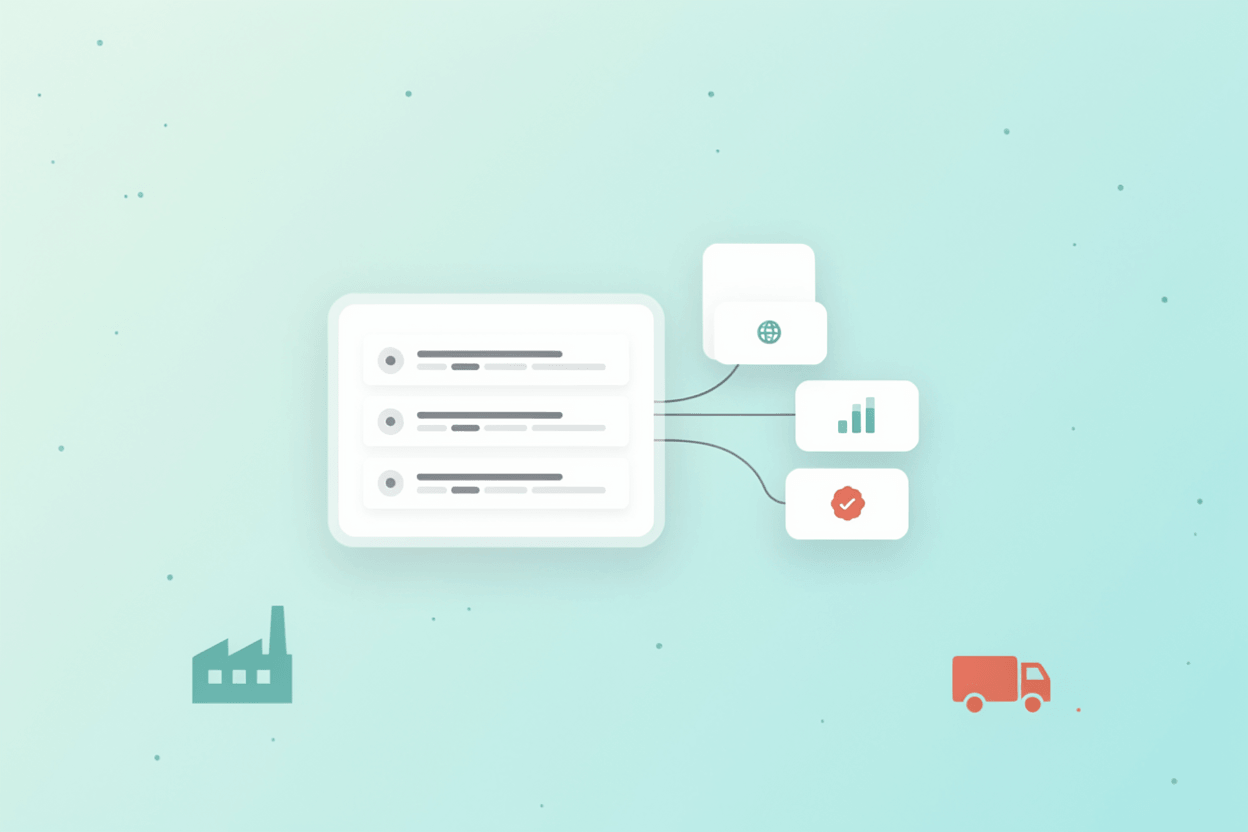
A supplier master data management platform keeps one trusted record for every supplier and sends it to every system that orders from or pays that supplier. This article covers how the platform works, why manufacturers and distributors need one even when they are suppliers themselves, what daily work with it looks like, and what implementation takes. It assumes you already know your way around an ERP vendor master.
Key Takeaways
- Most supplier data problems start at record creation. A duplicate check before a supplier exists takes seconds, while merging two records with open orders and payment history takes days.
- Bank detail changes are where bad supplier data turns into lost money. A governed change workflow with an outgoing callback to a known number is the cheapest fraud control a finance team has.
- Suppliers need supplier MDM too. Their customers' due diligence questionnaires ask about sub-suppliers, and only structured supplier data answers them fast.
- AI helps with matching and with reading documents, as long as a person approves the result.
- Implementation effort grows with the number of source systems and with the share of records that lack a VAT ID or registration number, because those records end up in manual review.
- The implementation style decides more than the feature list. Creating suppliers in the platform first gives control. Letting the ERP keep creating them gives speed.
What A Supplier Master Data Management Platform Does
Master data is the slow-moving reference data that transactions point to: suppliers, customers, products, materials. Master data management (MDM) is the set of rules and software that keeps one authoritative version of each record and controls how it changes.
A supplier record is rarely a single row. Good models separate the legal entity from its sites, bank accounts, contacts, and certificates, because each of these changes on its own schedule and has a different owner. Our article on the supplier master data model covers that structure. Here the focus is on what the platform does with it.
The platform pulls supplier records from every source: one or more ERP vendor masters, the procurement suite, the AP tool, and the spreadsheets purchasing keeps on the side. It standardizes formats, so "GmbH" and "Gesellschaft mit beschränkter Haftung" stop being two companies. It matches records that describe the same supplier and merges them into a golden record, the single version every system should use. Survivorship rules decide whose value wins for each field. Then the platform publishes the golden record back to the consuming systems, with a global supplier ID as the shared key.
Governance sits on top. Who may create a supplier and who approves a bank change become rules the software enforces. A wiki page with the same rules is easier to write and easier to ignore.
The platform overlaps with tools most companies already pay for, which confuses budget discussions. An ERP vendor master holds what that one ERP needs to post invoices. It has no view of the second ERP in the plant acquired three years ago. A supplier portal collects data from suppliers and stops there. A source-to-pay suite runs purchasing processes and often includes a supplier module, which works well when the suite is the only system touching suppliers. In most manufacturers, it is one of several.
Two implementation styles cover most supplier projects. In a centralized setup, every new supplier is created in the platform first and then pushed to the ERP. Control at onboarding is strong, and every new supplier now waits on the platform's workflow. In a coexistence setup, the ERP still creates suppliers, and the platform matches, cleans, and syncs the result back. Rollout is faster, and duplicates get caught after creation instead of being prevented. Many companies start with coexistence, then move new-supplier creation and bank data to the centralized model once the workflows hold up.
Why Supplier Data Breaks Without A Platform
Search the vendor master of a company that runs more than one ERP for its largest steel supplier. You will often find more than one record. Each plant created the version it needed. An acquisition brought its own vendor list. Someone used the trading name, someone else the legal name.
Duplicates have direct costs. Spend splits across IDs, so the buyer negotiating volume discounts works with half the real number. Many AP duplicate-invoice checks compare invoices within one vendor ID, so the same invoice entered under two IDs can get paid twice.
Then the copies drift apart. Supplier data changes all the time, and each change lands in one system first. A supplier moves its warehouse, logistics updates its spreadsheet, and purchase orders from the ERP keep going to the old address. A supplier agrees to new payment terms, finance updates one ERP, and the other keeps paying on the old schedule. Nobody did anything wrong. The other systems simply never heard about it.
Compliance data ages the same way. Certificates expire without anyone noticing, because the expiry date sits in a PDF in a shared folder. Electronic invoices carry the supplier's VAT ID, and a mismatch with the vendor master stops automated invoice matching for a supplier who did nothing wrong.
Every one of these problems traces back to one gap: no system owns the supplier. A supplier master data management platform keeps one record per supplier, and every connected system reads from it.
Why Suppliers Need Supplier MDM Too
Most manufacturers and distributors buy and sell in the same supply chain. A maker of hydraulic valves buys castings and seals and sells to machine builders whose purchasing teams run their own supplier MDM.
That middle position means customers ask questions only the supplier's own supplier data can answer. Due diligence laws such as Germany's LkSG require large companies to assess human rights and environmental risks among their suppliers, and those companies pass the questions down the chain. The valve maker gets asked which foundries pour its castings and whether those foundries hold the certificates the customer requires.
A flat vendor list cannot answer that. The questions come per product, so each supplier record needs links to its sites and to the materials each site delivers, with certificate and screening status on the right record. They also come in each customer's own questionnaire format, asking for the same facts in a different layout. A supplier that holds those facts once, as structured fields on governed records, fills every questionnaire from one source. One that rebuilds each answer from email threads, answers late or answers wrong, and the next customer asks again.
Upstream, the supplier has the problems of any buyer: duplicate vendors and stale bank data. In distribution, where margins are thin, those errors reach the P&L quickly.
How Teams Use A Supplier MDM Platform Day To Day
Consolidating Records From Several Sources
Consolidation is the first project and a recurring one. Every acquisition or ERP migration brings another vendor list.
The order of work matters. Import everything into a staging area first, untouched. Normalize names, legal forms, addresses, and country codes. Match on hard identifiers before anything else: VAT ID, company registration number, DUNS number, or LEI. Then run fuzzy matching on name and address for records without identifiers. Send uncertain matches to a review queue instead of merging them automatically. Decide survivorship rules per attribute group before the first merge, for example, bank data from the finance-owned system and contacts from procurement. Undoing a wrong merge after payments have posted against the golden record is slow work.
In AtroCore, this flow runs on three layers. Source entities hold the imported records as they arrived, or close to it. Data pipelines map them into a contributor entity, which mirrors the master entity's data model without mandatory or unique fields and serves as the staging layer for unification and duplicate detection. The master entity holds the golden records. A scheduled job groups likely duplicates into clusters based on the matching rules. A steward confirms or rejects each cluster item, or the job confirms items automatically when their matched score reaches a configured minimum. During confirmation, a consolidation script decides which values reach the master record. With automatic master updates switched on, later changes to a contributor record flow into the master record without another confirmation (details in the AtroCore help center).
Onboarding A New Supplier
A buyer requests a new supplier with a minimum data set. Before anything gets created, the platform searches existing golden records by VAT ID, registration number, and normalized name. This catches requests for suppliers that another plant already uses.
Validation runs at entry. The VAT ID matches its country's format and, for EU numbers, gets checked against the VIES service. The IBAN passes its checksum. Mandatory fields depend on supplier type. The supplier then completes the rest through a self-service form and uploads documents. Purchasing and finance approve in sequence, and only then does the record become active and receive its ERP vendor number.
The ERP will accept a third record for the same supplier without complaint. It has no opinion on the matter. The platform does.
Match the effort to the risk. A one-off purchase of conference catering should not go through the same 40-field process as a sole-source supplier of safety-critical parts. When onboarding is heavy for everyone, buyers route around it with one-time vendor accounts, and that is where duplicates and fraud come back in.
Keeping Certificates And Compliance Data Current
Each certificate is its own record with type, scope, issue date, expiry date, and an owner. The platform sends reminders well before expiry and moves the supplier to a restricted status when a mandatory certificate lapses. An automotive parts supplier without a valid IATF 16949 certificate should not receive new purchase orders, and the system should enforce that without someone having to remember.
Sanctions screening runs on a schedule and again whenever the legal name or ownership changes. Due diligence answers work best as structured fields instead of PDF attachments. Then a request like "show all suppliers that source cobalt from a given country" becomes a filter instead of an email campaign.
Spend Analysis And Sourcing Decisions
Parent-child hierarchies roll spend up to group level. Classification codes such as UNSPSC or ECLASS group it by category. Together they show when four "different" suppliers belong to one group, which changes the negotiation.
At product level, supplier data meets product data, and sourcing decisions depend on both. In projects we implemented, Activate Scientific, a European supplier of chemical building blocks for drug research, managed more than 150,000 SKUs bought from many suppliers whose prices changed often. Buyers compared sources by hand, and sales prices were recalculated manually. The foundation of the solution is a data model that links each product to its suppliers with purchase price, stock, and supplier rating, refreshed by a daily import from the ERP. A selection algorithm runs on top of that data. It flags non-optimal suppliers and proposes a replacement with recalculated selling prices, applied automatically or after a manual review in Excel.
Feeding The ERP And Other Systems
Distribution decides whether the golden record matters. Each attribute gets one owning system, and the others only read. Critical changes, such as a payment block or new bank details, go out as events within minutes. Low-risk fields like a contact's job title can travel in a nightly batch. A cross-reference table links each ERP vendor number to the global supplier ID. When an ERP gets retired, that table tells you which records to migrate and which are dead weight.
Where AI Helps In Supplier MDM
Matching is the most mature use, because rules struggle with abbreviations and transliterated names. Researchers at the University of Mannheim found that the best large language models need no or only a few training examples to match entity records as well as language models fine-tuned on thousands of labeled pairs, and they handle unfamiliar records better (source: Peeters, Steiner and Bizer, Entity Matching using Large Language Models). The same study found that prompts need tuning for each model and dataset, and it tested on public benchmark data. Run a test on your own supplier records before trusting any accuracy figure.
Document work is the other practical use. A model can read a PDF certificate and fill in its expiry date and scope, or suggest a category code from purchase order text. In both cases, the model proposes, and a steward decides. The platform logs who approved each value, so the audit trail looks the same whether a person or a model wrote the first draft.
What Implementation Takes
Effort depends more on the data and systems around the platform than on the platform itself, so it is easier to estimate from its drivers than from a generic vendor timeline. The main drivers are the number of source systems, the number of systems that consume supplier data, the countries in scope with their VAT and address formats, and the share of records with no hard identifier.
That last driver sets the size of the review queue, so run the numbers before committing to a date. Suppose profiling finds 20,000 supplier records across three ERPs, and fuzzy matching sends 3,000 candidate pairs to review. Assume about a minute per pair, and that is 50 hours of focused steward work. Stewards also have day jobs, so those hours over weeks.
The work usually runs in this order:
- Profiling and decisions: count records per source, measure how often VAT ID and registration number are filled, and agree attribute ownership and survivorship with finance and procurement. This phase moves fast when decision-makers are available and stalls when they are not.
- Model and rules: configure entities, validations, and matching rules, then tune matching on a sample until finance accepts the false-match rate.
- First consolidation: import into staging, match, clear the review queue, and merge. The review queue sets the pace.
- Integration: connect each ERP and the AP tool, load the cross-reference of old vendor numbers, and test against a full payment run in a test system before go-live.
- Workflows: switch on bank changes and new-supplier creation first, because they carry the most risk. Certificate tracking and due diligence fields can follow in a second release.
- Steady state: budget steward time for the daily queues. Matches nobody reviews pile up fast.
Two decisions shorten every phase. Name the stewards before the project starts. And limit the first release to the fields that payment and purchasing decisions depend on today. A 200-field supplier form at go-live slows every phase after it.
What To Check When Choosing A Supplier Master Data Management Platform
Requirements differ by company, but these checks separate platforms that work for supplier data from those that only demo well:
- Data model: legal entity, site, bank account, and certificate as separate linked entities, with new fields added without waiting for a vendor release.
- Matching: rules on hard identifiers plus fuzzy name and address comparison, a staging area, and a review queue for uncertain matches.
- Workflow and permissions: approval chains and field-level access, so bank data follows its own rules.
- Audit trail: old value, new value, user, and timestamp for every field with financial or compliance relevance.
- Integration: full API coverage and event-based sync with your actual ERP versions, including the old one that only accepts file imports.
- Deployment and licensing: cloud or on-premises, open source or proprietary, and who owns the configuration if the vendor relationship ends.
The trade-offs are real. An MDM module from your ERP vendor fits that ERP closely, and the fit tends to weaken once systems from other vendors join. A standalone platform connects to anything with an API, and that flexibility means more integration design up front. Neither choice assigns ownership. A platform without named data stewards becomes a well-indexed copy of the old mess.