


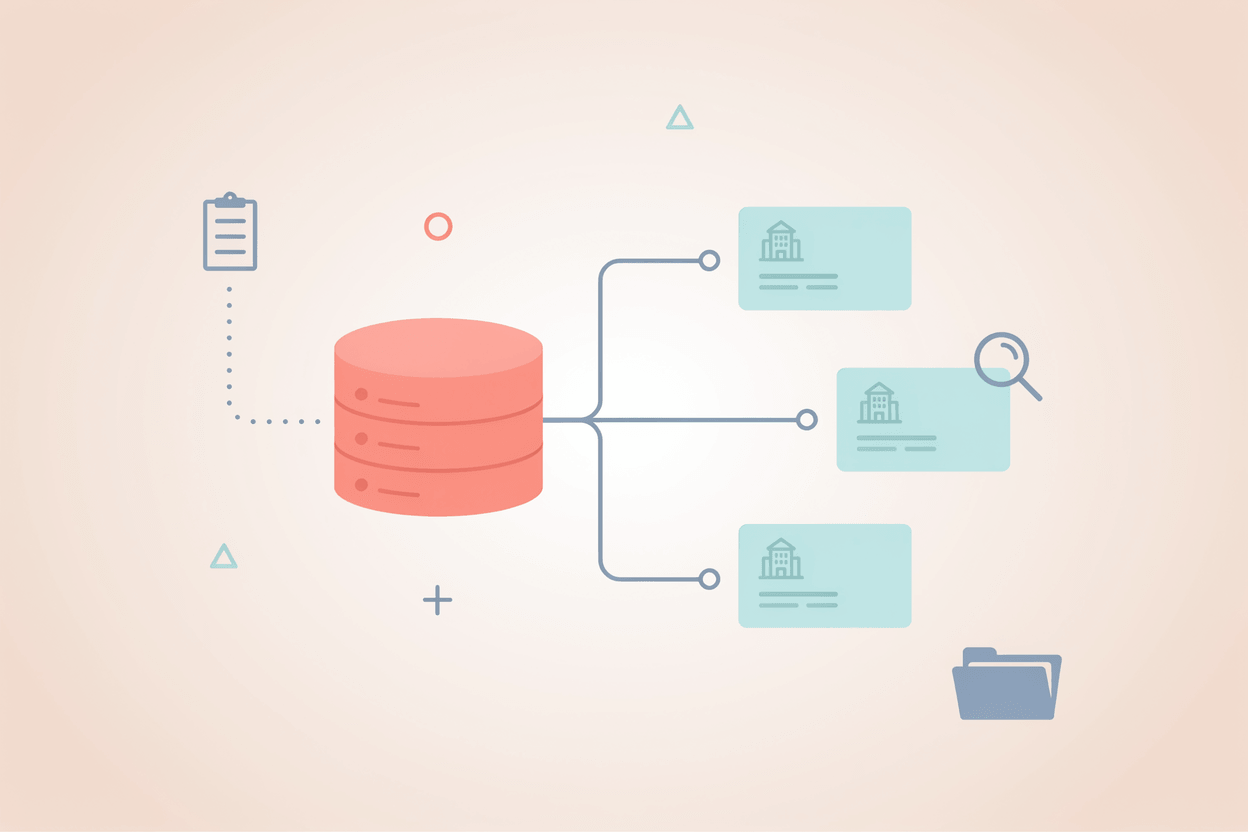
Supplier costs tend to leak away quietly. A duplicate vendor record slips in, a bank account is wrong, a tax ID goes unchecked, and an invoice gets paid twice because two systems hold two versions of the same supplier. No single mistake looks big enough to chase, so it goes unchased, and the small losses add up.
Supplier master data management is the discipline that stops that slow leak. It keeps one accurate, governed record for every supplier and shares it across the systems that need it.
This guide covers what it is, why it matters, and how to improve it. It also covers the point where a spreadsheet stops coping and dedicated software starts to earn its cost.
Key Takeaways
- The discipline creates one governed record, a "golden record", for each supplier and reuses it across ERP, procurement, and finance.
- A 2020 Gartner benchmark put the cost of poor data quality at $12.9 million a year for the average organization, a figure widely quoted since.
- About 21% of business partner records go out of date within a year, and 16% are duplicates, according to CDQ.
- Good practice combines clear ownership, validation at entry, deduplication, enrichment, and continuous monitoring.
- Dedicated software starts to pay off once manual checks and reconciliation stop scaling.
What Supplier Master Data Management Means
Supplier master data is the core, non-transactional information about the companies you buy from. Legal names, addresses, tax IDs, bank details, payment terms, contacts, and compliance status. It sits behind every purchase order and every payment.
Managing it is how you create, validate, govern, and maintain that information over time. The goal is a single source of truth. One authoritative record per supplier, the golden record, that stays clean and consistent wherever it is used.
Some teams call it vendor master data management. Procurement teams sometimes fold it into a wider procurement data program. The label changes. The underlying job does not. You keep supplier records accurate and make them usable across ERP, sourcing, accounts payable, and reporting.
Why It Matters More Than It Looks
The cost of bad supplier data is easy to underestimate because it hides inside normal operations. A 2020 Gartner benchmark put the average cost of poor data quality at $12.9 million a year. Treat it as an order of magnitude rather than a live number, since it has been recycled across the industry for years. The point holds either way. The cost rarely comes from one failure. It builds up from delayed payments, rework, and decisions made on wrong figures.
Supplier data also decays on its own. CDQ's benchmarks show about 21% of business partner records go out of date within a single year, and 16% are unintended duplicates. Suppliers move, rebrand, switch banks, and get acquired. A record that was correct at onboarding drifts out of date without anyone touching it.
Duplicates are worse than an annoyance. They break spend analysis, because one supplier looks like three. They weaken compliance screening, because checks run against fragmented records. And they open the door to fraud.
The link to fraud is worth taking seriously, though one case does not prove a pattern. In a single enterprise analysis, SAS found 7,216 vendors with different names sharing a single address. It also found 4,745 vendors sharing one bank account, plus 788 employees sharing a bank account with a vendor. SAS is careful to note these overlaps are not proof of fraud on their own. They can come from plain data quality problems. That is the point. None of it is visible when supplier data sits in silos, and a governed master record is what surfaces it for a closer look.
The Problems We See In Real Projects
Our customers usually turn to us with the same story. Supplier data lives in several places at once. An ERP system, a handful of spreadsheets, a procurement tool, sometimes a second ERP from an acquisition. Each holds a slightly different version of the truth, and nobody is sure which one is right.
In projects we implemented for manufacturers, the first pass almost always finds duplicate suppliers created because someone spelled the name differently or added a legal suffix. "Acme GmbH" and "Acme G.m.b.H." become two vendors. Payments split across them. Reports mislead.
These problems existed long before any software was involved. They come from manual entry, no naming rules, and no single owner for supplier data. Software helps, but only after the rules are clear.
Best Practices To Keep Supplier Data Clean
Assign clear ownership.
Someone has to own supplier data. Governance stays abstract until you name a data steward and give them authority over definitions, standards, and the onboarding process. Without an owner, quality drifts back down after every cleanup.
Define the data model and mandatory fields.
Decide what a complete supplier record looks like before you load anything. Which fields are required, what format they take, and which get validated against outside sources. A short list you enforce beats a long list you ignore.
Common mandatory fields include:
- Legal name and legal form, in a standardized format
- Registered address and country
- Tax or VAT identifier
- Bank account details, validated against the legal entity
- Primary contact and agreed payment terms
Validate at the point of entry.
It is far cheaper to catch an error when a record is created than to clean it later. The widely cited "1-10-100" rule captures the idea. A small cost to verify at entry, ten times that to fix it later, a hundred times that if it is never fixed. Put the validation rules at the front door, especially during supplier onboarding.
Deduplicate and build golden records.
Match records across systems using more than exact names. Compare addresses, tax IDs, and bank details. Merge confirmed duplicates into one golden record and keep an audit trail. This is where "single source of truth" stops being a slogan and becomes a table you can point to.
Enrich from trusted external sources.
Fill gaps and confirm details against reference data such as business registries and tax databases. Enrichment cuts manual entry and catches records that look fine but are wrong.
Control the full supplier lifecycle.
Onboarding is only the start. The work covers updates when details change, deactivation when a supplier is offboarded, and reactivation when you re-engage. Records left active forever are records that rot.
Integrate with the systems that use the data.
A golden record helps only if it reaches your ERP, procurement, and accounts payable tools. Sync it. Do not copy it by hand. Manual re-entry is how duplicates come back.
Monitor continuously with KPIs.
Data quality degrades from the day you finish cleaning it. Track completeness, duplicate rate, and how many records fail validation. Review the numbers on a schedule, not after a problem.
Clean once, and you have a project. Monitor continuously, and you have a system.
One company's numbers show the upside, with the usual caveat that a single case is not a promise. After moving to automated, validated onboarding for its customer and supplier records, Nestlé reported creating 80% of new records in under a day and cutting transaction costs by 14%. Your mileage will differ, but the mechanism behind it is boring and repeatable. Validate at entry, enrich from trusted sources, keep one record.
When To Introduce Dedicated Software
Spreadsheets work at small scale. They stop working when the count of suppliers, systems, and rules grows past what a person can check by hand. A few signs you have reached that point: duplicate payments show up, onboarding drags on for days, audits turn into a manual scramble, and every report needs reconciling before anyone trusts it.
Dedicated supplier master data management software centralizes records, enforces validation, automates deduplication, and syncs the golden record to other systems. When you evaluate tools, look for:
- A flexible data model you can shape to your supplier fields, not a fixed template
- Configurable validation and deduplication rules
- Connectors to your ERP, procurement, and finance systems
- External data enrichment and full audit trails
- Role-based workflows for onboarding and change requests
Weigh flexibility against fit for your case. Supplier records differ by industry, region, and regulation, so a rigid template can force workarounds, while a very open system can take more effort to configure and maintain. Judge it against how varied your supplier data actually is. Configurable platforms, AtroCore among them, let you model supplier data around your own fields and govern it in one place, which helps most when your records do not fit a standard shape.
Start small. Pick your worst problem, usually duplicates or missing bank validation, and fix that first. Set ownership and validation rules so the fix holds. Clean supplier data is not a one-time cleanup. It is a habit you build into onboarding and keep alive with monitoring.