


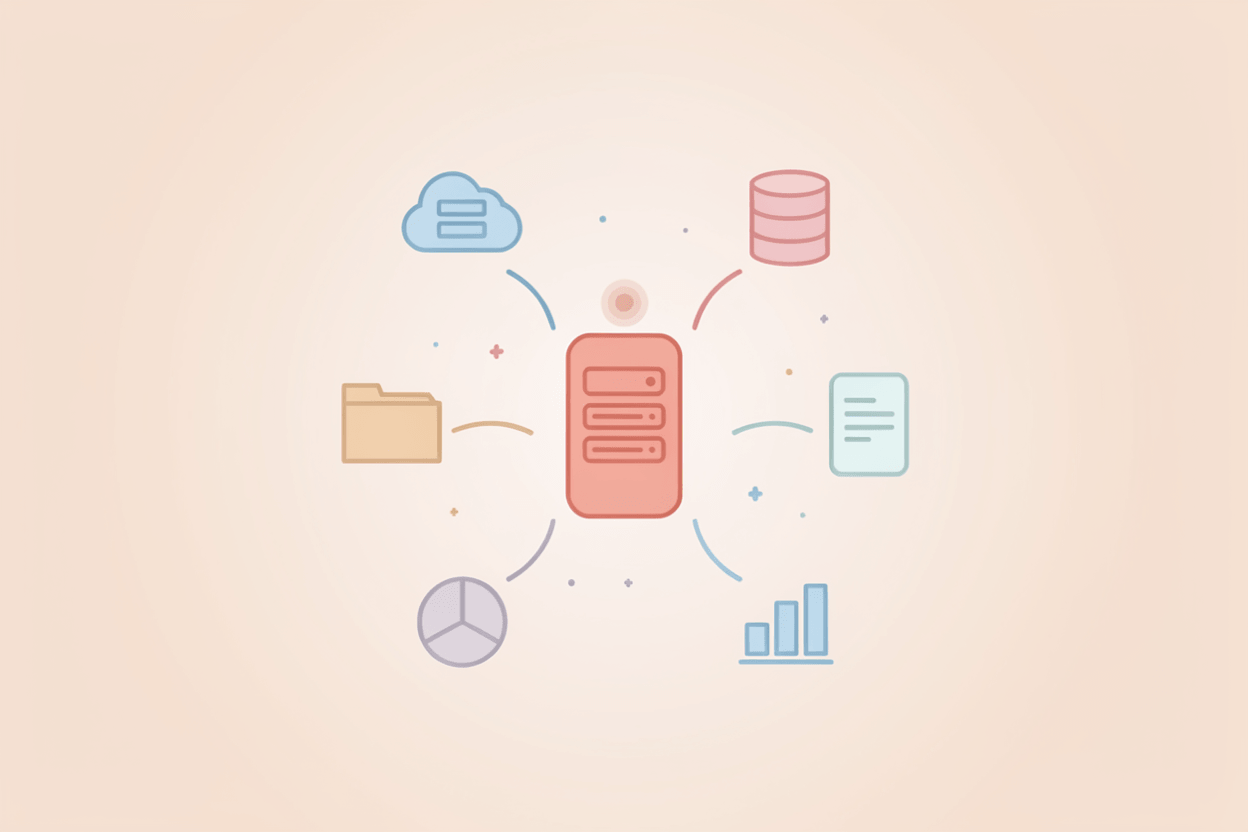
A single source of truth means one place your teams trust for a given piece of data. One product weight. One supplier address that everyone reads from. When that place exists, people stop arguing about which spreadsheet is right.
Most companies do not have this yet. Data sits in a CRM, an ERP, a few spreadsheets, and someone's inbox. Each copy drifts from the others over time. This article covers what a single source of truth is, why scattered data costs real money, and how to build one without buying the wrong tool.
What A Single Source Of Truth Actually Means
A single source of truth (SSOT) is a defined system that holds the authoritative version of a given data set. Other systems read from it or sync with it. They do not compete with it.
For any field, there is one place that wins when copies disagree.
A short example. Your online store shows a product as in stock. Your warehouse system shows it as sold out. Without an SSOT, a customer orders something you cannot ship. With one, both systems read stock levels from the same source, so they agree.
Single Source Of Truth, Master Data Management, And Data Mesh
Three terms get mixed up here, and the difference matters when you pick an approach.
A single source of truth is the outcome you want. One trusted version of a given data set.
Master data management (MDM) is the discipline and tooling that produces that outcome for your core shared data: the customers, products, and suppliers that many systems depend on. An SSOT for master data is usually the result of an MDM effort. MDM is the method. SSOT is the goal.
Data mesh points the other way. It is a decentralized approach where each domain team owns and serves its own data as a product, with no central store in the middle. It exists because in large organizations, funneling everything into one physical repository does not scale. Teams that try it end up with a bottleneck and a queue.
This is where the real debate sits. A literal single store works well for a small or mid-sized company with a handful of core domains. At enterprise scale, read "single" as a single point of authority per domain. One owner, one agreed version, even when the data lives in several places, connected by integration and shared definitions.
For most companies reading this, a consolidated store per domain is the right starting point. The distributed approaches matter once you outgrow it.
Why Business Data Ends Up Scattered
Data spreads because tools multiply. Sales picks a CRM. Finance picks an ERP. Marketing builds its own stack. Each tool stores its own copy of customers, products, or orders. None of them was built to defer to the others.
Manual entry makes it worse. The same supplier gets typed into three systems with three spellings. A price gets updated in one place and forgotten in the rest. Gartner names inconsistency across sources, caused by data held in silos, as the hardest data quality problem to solve.
Then people build workarounds. Someone exports a report, edits it in a spreadsheet, and emails it around. That spreadsheet becomes a fourth version of the truth. Nobody knows it exists until it causes a problem.
Each copy of your data drifts a little further from the others every week. Nobody decides this. It just happens.
What Scattered Data Costs You
The cost is not abstract, though the headline figures are worth reading with care. Gartner's 2020 research put the average cost of poor data quality at $12.9 million a year. That number is self-reported by large firms, and it is aging, so treat it as a directional benchmark rather than a precise measure. It still points the right way. Small errors pile up as wrong addresses, duplicate records, and decisions made on numbers that are weeks out of date.
A 2017 MIT Sloan analysis by Thomas Redman framed the loss differently, at 15% to 25% of revenue for most companies. Different method, same direction.
There is a time cost too. A 2012 McKinsey study found that workers spend close to 20% of the workweek looking for internal information. The study is old, but nobody who has searched four systems for one number will find it implausible.
And you cannot fix what you do not measure. Gartner has also found that 59% of organizations do not measure their data quality at all. So the losses stay invisible until something breaks in public.
How To Build A Single Source Of Truth
Building an SSOT is mostly organizational work with a software layer on top. The steps below hold for a small catalog or a large enterprise.
Start by picking the data that hurts most. You do not need one truth for everything on day one. Find the data that causes the most rework or the most customer complaints. Product data and customer records are common starting points.
Then assign an owner for each data domain. An owner is a person or team accountable for that data being correct. Without clear ownership, quality drifts back to where it started. Gartner points to lack of ownership as a core reason data quality programs stall.
Next, define the fields and rules. Decide what "correct" looks like before you build anything:
- The format each field takes, like phone numbers, currencies, and units
- Which fields are required before a record can go live
- How duplicates are identified and merged
- Which system is allowed to change which field
Write these rules down. They become the checks your system enforces later.
Now choose the master system for each domain. This is the system that wins when copies disagree. Other systems sync to it. For product data, this is often a PIM system or a data management platform. For customer data, often the CRM or a dedicated MDM tool.
Connect the other systems through integrations. The master holds the truth. The rest read from it or receive updates from it. Real-time sync is ideal. Scheduled sync works when real-time is not practical.
Keep the data clean after launch. An SSOT decays without maintenance. Set up validation at the point of entry so bad data cannot get in. Run regular checks for duplicates and gaps. Assign the cleanup to the data owner, not to whoever happens to notice the problem.
What To Look For In Single Source Of Truth Software
Software will not create a single source of truth on its own. But the right tool makes it far easier to hold one. Here is what matters when you compare options:
- Flexible data model.
You can shape entities and fields to your business, not the other way around. - Integration options.
APIs and connectors to sync with your existing CRM, ERP, and web systems. - Validation and data quality features.
Rules, deduplication, and checks built into the tool. - Role-based access.
Control over who can see and change each field. - Import and export.
Bulk handling of messy data from spreadsheets and legacy systems. - Total cost.
Licensing plus implementation, not just the sticker price.
Open-source platforms are worth a look here, especially when your data model is unusual. AtroCore, an open-source data management platform, is one option teams use to consolidate product, supplier, and asset data into a single configurable model. Because the model is configurable, you shape it to your data instead of forcing your data into a fixed structure.
Whatever you choose, test it against your real data before you commit. A demo with clean sample data hides the problems. Load a messy export from your own systems and watch how the tool handles duplicates, odd formats, and missing fields.
A Pattern We See In Manufacturing
In projects we worked on, the same situation repeats. A manufacturer keeps product specs in engineering spreadsheets, prices in the ERP, and marketing copy in a separate content system. The full catalog is never right in any single one of them, so the website and the sales team work from different numbers.
Customers usually come to us after a first attempt has already failed, and that attempt almost always tried to merge every system at once. Narrowing the scope to one domain, product data, is what finally gets the project moving. The fields get consolidated into a single model, cleaned, and then synced outward to the shop and the ERP. The arguments about which price is correct stop soon after.
Common Mistakes To Avoid
The biggest mistake is treating this as a pure IT project. An SSOT changes how people work. If sales keeps its private spreadsheet, you have two sources of truth again. Buy-in from the teams who enter and use the data matters more than the software.
Another common error is trying to fix everything at once. Teams try to unify every system in one go, the project stalls, and nothing ships. Start narrow. Prove value on one domain. Expand from there.
People also underestimate maintenance.
An SSOT is not a project you finish. It is a system you run.
Budget for ongoing ownership from the start, or the data will drift straight back into silos.
Closing Thought
A single source of truth is less about technology and more about agreement. Pick the data that hurts, give it an owner, set the rules, and choose a tool that fits your model. Decide whether you need one store or one authority per domain, then start narrow, keep it clean, and expand once it works. The payoff is plain. People stop asking which number is right and start trusting the one in front of them.