


Every data team has been there. A dashboard shows revenue dropping 40% overnight, engineers scramble, and hours later, someone discovers a broken ETL pipeline was feeding nulls into the wrong column. A business decision almost gets made on bad data.
The stakes can be far higher. In Q1 2022, Unity Technologies suffered a data quality incident that cost the company approximately $110 million in revenue and triggered a 37% stock drop. Bad data had been ingested from a large customer into the ML model powering their ad targeting tool, and nobody caught it until the quarterly earnings collapsed. That kind of incident is not an anomaly. It is the predictable outcome of data quality approaches that do not scale.
Gartner estimates poor data quality costs organizations an average of $12.9 million per year. The Monte Carlo State of Data Quality report found that data professionals spend 40% of their time evaluating or checking data quality. These are not edge cases. They are what happens when quality enforcement stays manual while data volumes grow.
Data quality automation exists to change that equation.
What Is Data Quality Automation?
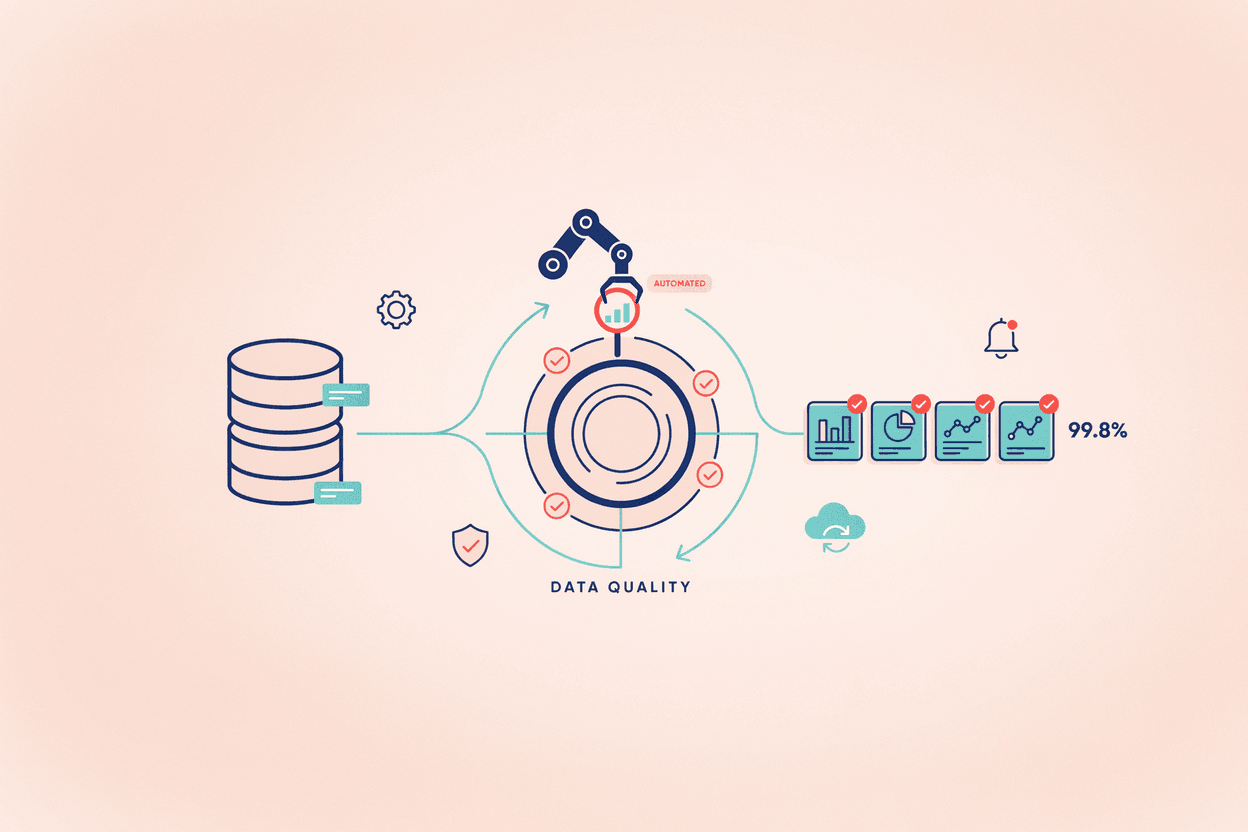
Data quality automation is the use of AI, machine learning, and rule-based systems to continuously monitor, detect, and resolve data quality issues without human intervention.
It goes beyond running a scheduled SQL script or a nightly DBT test. Automated data quality management adapts to changing data patterns, ties quality enforcement to business rules, and flags anomalies before they reach dashboards or downstream models.
The five core dimensions of data quality that automation typically governs are:
- Accuracy — Does the data correctly reflect reality?
- Completeness — Are expected values present?
- Consistency — Is data uniform across systems and time?
- Timeliness — Does data arrive when it is needed?
- Uniqueness — Are there duplicate records inflating metrics?
Why Manual Data Quality Doesn't Scale
Traditional approaches to data quality rely on static rules written by engineers. SQL assertions, DBT tests, hand-crafted validation scripts. These methods work at a small scale but collapse under modern data volumes for three reasons.
Volume and velocity. Organizations now manage terabytes of data flowing across dozens of systems in real time. Writing and maintaining manual rules for every table, column, and pipeline is not sustainable. As pipelines multiply, the maintenance burden grows faster than the team.
Rigidity. Hard-coded thresholds don't account for natural variation like seasonality, product launches, or regional differences. A rule that flags "orders < 1,000/day" as an anomaly will trigger false alarms every weekend. False alarms train teams to ignore alerts.
Reactive, not proactive. Manual checks typically run on a schedule. By the time an issue is caught at 2 AM, six hours of bad data may have already propagated into production models, reports, and ML features.
According to Monte Carlo's 2023 State of Data Quality survey, the average organization experiences 67 data incidents per month, each taking an average of 15 hours to resolve once discovered. That is roughly 1,000 engineering hours per month, per company, spent on cleanup.
Automated data quality monitoring directly reclaims that time.
How Data Quality Automation Works
Modern data quality automation platforms operate across four core functions.
Automated Data Profiling
Before you can enforce quality, you need to understand your data. Automated profiling scans datasets to establish statistical baselines: value distributions, null rates, cardinality, min/max ranges, and format patterns. This profiling happens continuously, not just once at pipeline setup. The system builds an evolving picture of what "normal" looks like for each dataset.
Without profiling, quality rules are guesswork. With it, they are grounded in how your data actually behaves.
Automated Data Quality Rules and Validation
Rather than requiring engineers to write every check manually, AI-powered platforms auto-generate data quality rules from profiling results. A column that historically contains values between 10 and 500 automatically gets a range check. An ID column with 100% uniqueness gets a duplicate check. Business terms from a data catalog or governance glossary can be mapped directly to technical validations, ensuring that rules reflect business intent rather than just technical constraints.
Automated Anomaly Detection
This is where machine learning earns its place in the data quality stack. Anomaly detection models learn the normal behavior of each metric over time and flag deviations that fall outside expected bounds, accounting for trends, seasonality, and day-of-week patterns. This replaces brittle threshold rules with adaptive, context-aware monitoring.
Automated anomaly detection is especially useful in real-time pipelines, where data arrives continuously, and issues need to be caught before they propagate. It also reduces false positives compared to static rule sets, which matters for keeping alert trust intact.
Automated Remediation
The most mature implementations go beyond detection to automated remediation. A foundational part of this is data cleansing: detecting and correcting corrupt, inaccurate, or irrelevant records at scale. Automated cleansing handles tasks that were once done manually:
- Deduplicating records and standardizing formats
- Filling predictable gaps and flagging out-of-range values
- Quarantining bad records before they enter production tables
- Triggering pipeline re-runs when upstream issues are detected
- Routing flagged data to a stewardship queue when automated correction is not safe
Automated remediation closes the loop. It turns data quality from a monitoring discipline into a self-healing system.
Key Benefits of Data Quality Automation
Faster Issue Detection
Automated checks run continuously. Teams catch data quality issues within minutes of ingestion rather than discovering them the next morning or, worse, after they have influenced a business decision. For pipelines that feed ML models or financial reporting, minutes versus hours matter enormously.
Reduced Engineering Burden
Auto-generated rules and ML-based anomaly detection cut the time engineers spend writing and maintaining quality checks. For manufacturers managing product data across multiple ERP systems and sales channels, the typical pattern before automation was one or two engineers spending most of their week reconciling data discrepancies between systems. After deploying automated profiling and anomaly detection, that same team shifts to reviewing flagged exceptions rather than hunting for issues, recovering 60 to 70 percent of that engineering time.
Higher Trust in Data
When business users know data is continuously validated and anomalies are caught early, they stop questioning numbers in meetings and start acting on them. Trusted data is a competitive asset. Bad data quietly erodes confidence in every dashboard, every AI model, and every analyst who presents from them.
Compliance and Data Governance Alignment
Automated quality checks create auditable records of data validation, which are essential for GDPR, HIPAA, SOX, and other regulatory frameworks. Linking quality checks to business glossary terms and governance policies means compliance requirements flow directly into operational monitoring instead of being bolted on at audit time.
Scalability Without Linear Cost
As data volumes grow or new pipelines are added, automated systems scale without proportional increases in manual effort. Automation decouples quality coverage from headcount. A team of five can monitor thousands of tables with the same rigor they once applied to fifty.
Core Use Cases
CRM and Revenue Operations
Dirty CRM data — duplicate contacts, missing revenue fields, inconsistent account hierarchies — silently distorts sales forecasts and attribution models. Automated data quality checks on Salesforce or HubSpot data catch these issues at ingestion, before they pollute pipeline reports.
We see this pattern frequently with manufacturers who manage their distributor relationships in CRM while product data lives in a separate PIM or ERP. Before automation, inconsistent account naming across systems would cause deals to be attributed to the wrong region or the wrong product line. Automated reconciliation checks between the two systems surface those mismatches before they reach the reporting layer.
Data Warehouse and Lakehouse Pipelines
Automated monitoring on staging and production tables in Snowflake, BigQuery, or Databricks ensures that transformations don't introduce nulls, schema drift, or unexpected row count changes. This is especially important for organizations running dozens of interdependent DBT models, where a single upstream data issue can cascade through an entire reporting layer.
ML Feature Stores and AI Pipelines
Models trained on bad features produce bad predictions. And unlike a broken dashboard, a corrupted ML model may not surface obvious symptoms immediately. The Unity Technologies incident is the clearest example of this pattern at scale: corrupted training data degraded model performance for an entire quarter before the financial impact became visible. Automated data quality gates on feature pipelines prevent corrupted, stale, or out-of-distribution data from reaching model training or inference endpoints.
Financial Reporting and Regulatory Compliance
Month-end close and regulatory reporting leave no room for data errors. Automated reconciliation checks between source systems and reporting layers catch discrepancies before they become audit findings or restatements.
MDM and Golden Record Management
In Master Data Management environments, data quality automation is essential to maintaining the integrity of golden records. Merged entities must not carry forward conflicting or low-quality source data. Open-source MDM platforms like AtroCore handle product and entity data across multiple channels, where automated quality checks at the attribute level keep master records clean as data flows in from disparate sources.
Implementing Data Quality Automation: A Practical Framework
Rolling out data quality automation does not require replacing your entire stack overnight. A phased approach delivers value quickly while reducing implementation risk.
Phase 1: Profile and Baseline (Weeks 1–2)
Start by running automated profiling on your most critical datasets. Focus on the tables powering your most-used dashboards and highest-stakes decisions. Establish statistical baselines before writing any rules. Understand the shape of your data before you try to govern it.
Phase 2: Define Data Quality SLAs (Weeks 2–3)
Work with business stakeholders to define what "good" looks like for each dataset. What null rate is acceptable? What is the expected row count range per day? What columns are business-critical? Translating business expectations into measurable thresholds creates shared accountability and gives your automation system clear targets.
Phase 3: Deploy Auto-Generated Checks (Weeks 3–4)
Use profiling results to auto-generate an initial rule set. Review, refine, and activate checks in monitoring mode first — observe what fires without taking automated action yet. This calibration period prevents alert overload and builds confidence in the system before you enable enforcement.
Phase 4: Enable Alerting and Triage Workflows (Month 2)
Connect anomaly alerts to your incident management workflow (Slack, PagerDuty, Jira). Build a triage process so that when data quality checks fail, ownership is clear and response times are tracked. Assign data quality SLA owners for each critical domain.
Phase 5: Expand Coverage and Automate Remediation (Month 3+)
Gradually expand automated monitoring to lower-priority datasets and introduce automated remediation actions for well-understood, repeatable issues. Track data quality metrics over time to demonstrate ROI and guide future investment.
Choosing the Right Data Quality Automation Tools
| Category | Representative Tools | Best For |
|---|---|---|
| Observability-focused | Monte Carlo, Metaplane, Bigeye | Data engineering teams in cloud-native stacks who need fast time-to-value |
| Governance-integrated | IBM Watson Knowledge Catalog, Collibra, Alation | Enterprise orgs with formal data governance programs and compliance requirements |
| Pipeline-native | Great Expectations, DBT tests + Elementary | Teams that want quality checks embedded close to the transformation layer |
| AI-native DQ platforms | DQLabs, Soda, Ataccama | Teams prioritizing ML-based anomaly detection and automation at scale |
When evaluating tools, the questions that matter most are:
- Does it integrate natively with your data warehouse and orchestration layer?
- Does it use ML-based anomaly detection, or only static thresholds?
- Can it link quality checks to your business glossary or governance framework?
- Can it monitor thousands of tables without manual configuration per table?
- Does it explain why a check failed, not just that it failed?
- Does it support automated fixes, or only alerting?
Common Pitfalls to Avoid
Over-alerting early on. Activating too many data quality checks before baselines are stable leads to alert fatigue. When everything is flagged, nothing gets fixed. Start narrow with your highest-priority datasets, prove value, then expand.
Ignoring data producers. Data quality automation works best when upstream teams — data engineers, source system owners, business application teams — are part of the loop. Quality is a shared responsibility across the pipeline, not a downstream cleanup task.
Skipping business context. Technical checks divorced from business meaning create noise. A completeness check on a column that is intentionally nullable for certain product types will always fail. Tie automated rules to business logic from the start.
Treating it as a one-time project. Schemas change, pipelines evolve, and business rules shift. Build processes for continuous rule review, metric tracking, and stakeholder feedback loops. The teams that let their rule sets go stale end up back where they started within a year.
The Next Wave: Agentic and AI-Native Data Quality
The next frontier in data quality automation is agentic AI. Systems that do not just detect and alert, but autonomously investigate root causes, trace data lineage to identify the origin of an issue, communicate findings in plain language, and orchestrate multi-step remediation workflows.
Data contracts are emerging as a complementary upstream mechanism: formal agreements between data producers and consumers that define expected schemas, formats, and SLAs before data enters a pipeline. Where automation catches issues after the fact, data contracts prevent them at the source. The two work best together.
Early implementations already use large language models to translate business rules into automated validation logic, explain anomalies in plain English to non-technical stakeholders, and suggest remediation steps based on historical resolution patterns. Some platforms are beginning to generate and deploy new quality checks in response to observed incidents.
As AI agents become more deeply embedded in data platforms, the human role in data quality management will shift from writing rules and chasing errors to reviewing agent recommendations, setting quality policy, and governing the automation itself. Organizations that build this capability now will carry a structural advantage as AI-driven analytics and decision-making become standard.
Where to Start
The organizations that get the most out of data quality automation are not the ones that try to monitor everything from day one. They start with the datasets that their most important business decisions depend on. They establish baselines, automate the obvious checks, and build from there.
The ROI shows up fast: in engineering hours reclaimed, data incidents avoided, and the growing trust that business users place in the numbers they act on.
Audit which datasets your highest-stakes decisions currently depend on. Those are your first automation targets.