


64% of organizations cite data quality as their top data integrity challenge, and 67% say they don't fully trust the data they use for decisions. Both problems share a common root: most organizations can't reliably trace where their data came from or what happened to it along the way. That's a data lineage problem. And for organizations running more than a handful of pipelines, it's more common than most teams admit.
What Is Data Lineage?
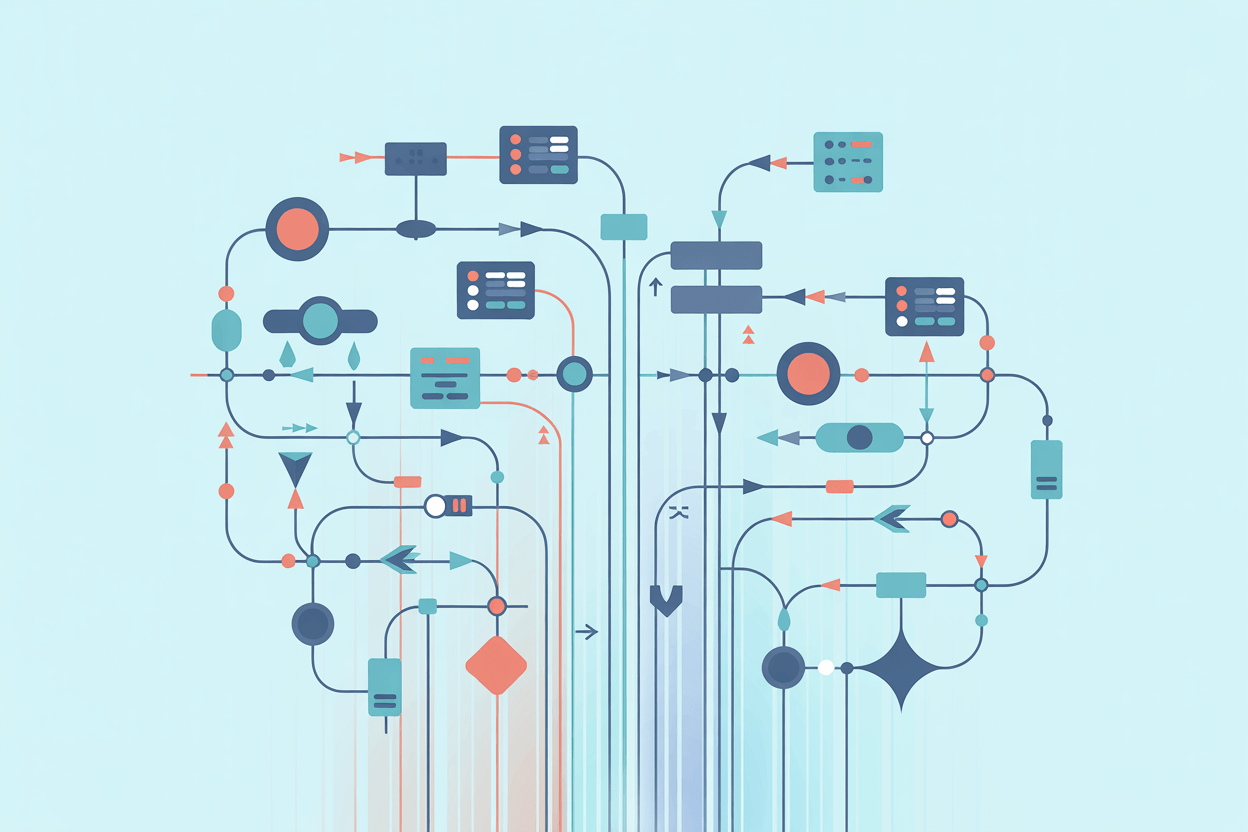
Data lineage is the end-to-end record of how data moves through your systems. It captures where data originates, how it moves between systems, what transformations it undergoes, and where it ends up, including every enrichment, filter, join, aggregation, and calculation along the way.
Data lineage answers three core questions: Where did this data come from? What happened to it? Where does it go next?
This is different from data provenance, which focuses on origin and custody. Data lineage covers the full data lifecycle: source, movement, transformation, and consumption.
A concrete example: a product price field starts in an ERP system, gets cleaned and normalized in an ETL job, lands in a data warehouse, and feeds into a pricing dashboard. Data lineage maps all of that. Without it, when the dashboard shows a wrong price, the team is guessing at which step broke.
Data lineage is also a core component of data governance. It gives governance teams the visibility needed to enforce data policies, track data ownership, and manage data quality across the organization. Without it, data governance stays largely theoretical.
Why Data Lineage Matters
Trust in your data.
When analysts can see where a number comes from and what touched it, they use it with confidence. When they can't, they question everything or work around the systems entirely. Data lineage makes data trustworthy by making it traceable, and that's the foundation of data integrity across reporting, analytics, and decision-making.
Faster root cause analysis.
Data lineage helps teams trace pipeline errors back to their source, cutting debugging time significantly. A broken report that would otherwise take hours to investigate becomes a traceable path. With column-level lineage, which tracks individual fields rather than whole tables, teams can isolate the exact transformation that caused a problem.
Regulatory compliance.
Regulations, including GDPR, CCPA, HIPAA, BCBS 239, and SOX, require clear visibility into data flow. For GDPR specifically, data lineage supports the right to be forgotten and the ability to trace personal data across systems. If a regulator asks where a specific customer record was used, lineage gives you the answer. Without it, the audit becomes a manual excavation.
Impact analysis.
When a schema changes in a source system, lineage tools show which downstream assets are affected: reports, dashboards, machine learning models, and other data consumers. In complex data estates, visibility separates a controlled rollout from a weekend incident.
Data Lineage vs. Data Catalog
These two concepts are related but distinct, and the difference matters for implementation.
A data catalog is a centralized inventory of data assets and their metadata: what datasets exist, what they contain, and who owns them. Data lineage adds the dynamic layer. It shows how those assets relate to each other, how data flows between them, and what transformations happen along the way.
A catalog tells you what data you have. Lineage tells you where it came from and what happened to it. Used together, they form the backbone of a working data governance framework. Most modern data catalog platforms, including Collibra, Alation, and Microsoft Purview, have built lineage visualization directly into their interfaces because the two functions are hard to use separately.
Types of Data Lineage
There are two main categories, and most organizations need both.
Business lineage maps data relationships at the conceptual level: how a dataset connects to a business process, a KPI, or a compliance rule. It's built for analysts, data owners, and governance teams, and it focuses on the purpose of data and how it supports business objectives.
Technical lineage tracks system-level transformations: SQL scripts, ETL and ELT pipelines, joins, aggregations, and API calls. It's the tool data engineers and architects rely on when managing complex architectures.
Within technical lineage, granularity matters:
- Table-level lineage tracks how entire datasets flow across ETL pipelines and storage layers.
- Column-level lineage tracks individual fields, showing exactly which source columns feed which target columns through transformations. This is the most precise form and the most useful for debugging and compliance work.
Some platforms add operational lineage, which captures runtime details: execution history, performance metrics, and success and failure logs. This feeds into data observability practices, combining lineage with real-time monitoring and anomaly detection.
In practice, business and technical lineage work together. A data owner uses business lineage to understand what a dataset represents and where it's used. A data engineer uses technical lineage to understand why the data looks wrong.
How Data Lineage Works
Data lineage works by capturing metadata about data at rest and in motion as it moves through processes, transformations, and storage layers. Lineage tools collect this metadata via connectors to databases, APIs, and monitoring solutions, then catalogue it in a metadata repository so that movement and transformations between source systems, ETL jobs, data warehouses, and reporting tools can be tracked continuously.
Three techniques are used to capture lineage in practice:
- Automated parsing reads source code, SQL queries, or pipeline configurations to extract lineage without manual input. It scales well and integrates with orchestration tools like dbt, Apache Airflow, and Spark.
- Manual documentation relies on teams to document data flows themselves, typically in a metadata catalog or spreadsheet. Accurate when done well, but hard to maintain as systems evolve.
- Data tagging attaches metadata or unique identifiers to data as it moves through systems. Those tags persist, enabling tracking across the full data flow from source to destination.
Manual lineage is possible in small environments. In modern data pipelines, with high data volumes, diverse sources, and frequent changes, automation is the only practical approach at scale. And even automated lineage needs active maintenance. When documentation lags behind actual pipeline changes, data teams lose trust in lineage tools, and root cause analysis slows down.
How to Implement Data Lineage
Start with scope, not tools
Before choosing a tool, identify where lineage matters most. Regulatory requirements, critical reporting pipelines, and high-risk data assets are good starting points. Run a focused pilot to address either a compliance requirement or a specific business process, and scope it carefully.
Trying to map an entire data estate at once produces noise, not insight.
Choose the right data lineage tools for your architecture
Modern cloud pipelines running on Snowflake, Databricks, dbt, or Spark typically have data lineage tools that capture lineage natively or through connectors. The OpenLineage standard provides an open framework for collecting lineage metadata across platforms, making cross-stack integration more consistent. Commercial platforms like Collibra, Atlan, Alation, and Microsoft Purview offer end-to-end lineage visualization built for these environments.
The right tool is the one that fits your existing stack, not the one with the most features on paper.
In more fragmented environments, start with a metadata catalog that supports manual documentation and add automation as systems standardize.
Build lineage into pipeline deployments
Lineage shouldn't be a retrospective exercise. Establish policies so that lineage is updated as part of change management and deployment workflows. When a new pipeline goes live or an existing one changes, lineage metadata should update automatically or as part of the release process.
Many implementations fall apart here. The initial documentation is solid, but it drifts as the team ships changes without updating the lineage records.
Standardize naming and metadata
Inconsistent naming breaks lineage. If a customer ID field is called cust_id in one system, customer_id in another, and CustID in a third, automated tools struggle to connect them without custom mapping rules. Standardized naming conventions and metadata schemas are foundational to any lineage program, and often the hardest part to get right because they require coordination across teams and touch data stewardship practices organization-wide.
Assign ownership
Lineage without ownership is documentation without accountability. Each dataset needs a designated owner responsible for keeping lineage accurate. Distributed ownership works, but it must be explicit and enforced through your data governance framework.
In our experience with manufacturers managing large product datasets across ERP, PIM, and e-commerce systems, one of the first problems we encountered was that no one owned the lineage for derived fields — calculated values like "effective price" or "available stock" built from multiple upstream data sources. When those fields showed wrong values, it took days to trace the issue. Responsibility was unclear. Assigning field-level ownership, even informally, cut resolution time significantly.
MDM platforms help anchor this ownership model. An MDM system consolidates product, customer, or supplier records from multiple source systems into a single governed record and becomes a natural point for defining who owns which data attributes and how those attributes were sourced. AtroCore is an open-source MDM platform designed for this kind of setup. It supports flexible data modeling and consolidation from multiple source systems, which gives teams a workable structure for managing field-level lineage and ownership across complex product data environments.
Data Lineage and Data Quality
Data lineage and data quality management are closely connected. Lineage doesn't just help when something breaks. It's also a preventive tool. When teams can see the full path a dataset traveled, they can identify where quality issues are likely to enter: a source system with inconsistent formatting, a transformation step that silently drops records, or a join that introduces duplicates.
64% of organizations cite data quality as their top data integrity challenge. Most of those problems originate at specific points in the data pipeline. Lineage makes those points visible.
This matters even more for AI and machine learning. Gartner predicts that through 2026, organizations will abandon 60% of AI projects unsupported by AI-ready data. Lineage is part of what makes data AI-ready: it provides the metadata trail that lets data scientists verify what training data was used, how it was processed, and whether upstream changes might affect model outputs.
Data Lineage and Data Observability
Data lineage is increasingly deployed alongside data observability tools, which monitor pipelines in real time for anomalies, freshness issues, and quality degradation. Lineage shows how data flows. Observability shows how it's behaving right now.
The combination gives data teams a complete operational picture. When an anomaly is detected, a field returning unexpected null values, for example, lineage immediately points to which upstream source or transformation is the likely cause. That narrows the investigation and reduces the mean time to resolution for data incidents.
What to Expect After Implementation
Most teams notice faster debugging first. When a dashboard breaks or a report looks wrong, data lineage gives engineers a map. They trace the issue upstream, find the transformation that caused it, and fix it rather than running queries across multiple systems.
Trust builds more slowly. When business users can see where a number comes from, they stop questioning it whenever it shows something unexpected. That reduces the overhead of repeated data validation meetings, and it compounds as more pipelines get documented.
Compliance becomes more manageable. Automated lineage lets compliance teams meet data traceability requirements without excessive manual documentation. When an auditor asks how a specific piece of personal data was processed and where it ended up, the answer is available in seconds.
What doesn't change quickly: adoption. Lineage tools take time to embed into team workflows. Engineers need to learn to consult lineage before assuming a problem is local. Governance teams need to keep metadata current as pipelines evolve. The infrastructure pays off, but only if the habits follow.