


Key Takeaways
- Data quality governance is not a one-time project. It is an ongoing operational discipline.
- Ownership, standards, and enforcement need to exist at the data level, not only in policy documents.
- Most failures stem from weak data modeling at the source, not from a lack of monitoring tools.
- Integrating quality rules into data pipelines prevents problems instead of reporting them.
Most organizations know their data has quality problems. Duplicate supplier records, product attributes that mean different things across systems, and missing values that only surface when someone tries to run a report. What is less clear is who owns those problems, and what should actually be done about them.
That gap is what data quality governance is supposed to close.
What Data Quality Governance Actually Means
Data governance and data quality are related but not the same thing. Governance defines the rules: who owns data, how it is classified, what standards apply, who has access. Data quality is the operational result: whether data actually meets those standards at any given moment.
Data quality governance is where the two connect. It is the set of processes, roles, and controls that translate a data governance framework into measurable data outcomes. Data quality management is the day-to-day execution of that work. The result, when both function correctly, is data integrity: records that are accurate, consistent, and trustworthy across every system that uses them.
A 2025 report by the IBM Institute for Business Value found that 43% of chief operations officers identify data quality issues as their top data priority. More than a quarter of organizations estimate they lose over USD 5 million annually because of poor data quality.
Those losses are rarely the result of a single bad decision. They accumulate from small, systemic failures: no agreed definition of what "complete" means for a product record, no process for catching duplicates before they reach downstream systems, no one accountable when data drifts out of spec.
The Real Failure Mode
Companies tend to treat data quality as a cleanup task. Something goes wrong, a team runs a correction script, and the issue gets closed. Three months later, the same issue is back.
The reason is structural. If the data model allows bad data through at ingestion, and there are no rules enforced at that point, data cleansing is always reactive. You are removing problems after they have already propagated into reports, pricing engines, ERP transactions, and customer-facing outputs.
The single biggest predictor of poor data quality is a data model that was never designed with quality in mind.
In projects we implemented for industrial equipment manufacturers, the root cause was almost always the same: attribute fields defined as free text, no controlled vocabularies, and no mandatory fields at the product level. Every team entered data differently. By the time the catalog reached the e-commerce platform, matching and deduplication required weeks of manual work before each product launch cycle.
Governance frameworks that focus only on ownership and access policies without touching the underlying data model will not fix this. Data quality governance starts upstream, at the point where data is defined and entered, not where it is reported.
What a Working Framework Looks Like
Data quality governance that actually holds up in production requires five components. Their importance is not equal, and the implementation sequence matters.
Defined quality dimensions with measurable targets
Accuracy, completeness, consistency, timeliness, uniqueness, validity, and conformance are the core dimensions of data quality. Usability covers whether data is structured in a way that downstream teams can actually work with it, and is worth adding when data crosses system boundaries. The definitions need to be specific. "Completeness" for a product record at a building materials distributor might mean all 14 mandatory attributes are populated, including unit of measure, hazard classification, and packaging dimensions. Each dimension also needs a target, a measurement method, and a review cadence. Without those three things, a quality dimension is just a label.
Data ownership at the attribute level
Assigning a data owner to a table or a domain is too coarse. Quality accountability works when it sits at the attribute level. Someone is responsible for the accuracy of the material number. Someone else owns the product description fields. When a field degrades, you know immediately whose job it is to fix it. Most organizations avoid this level of specificity until a regulatory audit forces it. Clear data governance roles, defining who owns what at what level of granularity, are what prevent that.
Validation rules embedded in ingestion
This is where most data quality governance programs either work or fail. Quality rules should fire at the point where data enters a system. A mandatory field left empty should fail the record outright, not pass it through and surface in a weekly data quality report three days later. A value outside an allowed set should be rejected at data ingestion, with a specific error message.
Our customers in the safety equipment distribution space often come to us after years of running post-ingestion quality checks. The checks existed. The data quality problems did not go away. The difference, once automated validation moved upstream into the data ingestion pipeline itself, was immediate: error rates dropped, rework cycles shortened, and downstream systems stopped receiving corrupted records. Data standardization, enforcing consistent formats, units, and controlled values at entry, made data quality metrics actually reflect reality rather than measure the output of a cleanup script.
Data profiling before building validation rules matters here. If you do not know the distribution of values in a field, the range of formats used, or where nulls cluster, the rules you write will be either too loose or too strict. Profiling turns assumptions into specifications.
Audit trails and data lineage
You cannot govern what you cannot trace. When a product specification changes, the system should record who changed it, when, and from what value. When a record fails a quality check, there should be a log of what rule it failed and what happened next.
In multi-system environments, lineage matters as much as the audit trail itself. A product record that originates in an ERP, passes through a PIM, and publishes to three sales channels can degrade at any point in that chain. Metadata management, capturing where each field came from and what transformations it passed through, is what makes it possible to pinpoint the entry point of a failure. A data catalog that indexes this metadata gives teams a single place to trace issues without interrogating each system individually.
Workflow approvals for critical data changes
Changes to pricing tiers, product classifications, or regulatory attributes typically need a second review before they are published. In industries with strict regulatory compliance requirements, such as chemicals, medical devices, and hazardous materials, an approval workflow is not optional. It is the mechanism that keeps governed data from being overwritten without a record. The approval step does not need to cover every change, only the ones where an error is costly to reverse.
These five components are mutually reinforcing. Ownership without validation rules means accountable people still receive bad data. Validation without lineage means you catch errors but cannot explain where they came from. A data quality governance program with all five in place at a basic level will outperform one that builds a single component well while leaving the others unaddressed.
The Organizational Side Is Harder Than the Technical Side
The technical components of data quality governance are well understood. The harder part is organizational.
Most companies have multiple teams touching the same data. The ERP team owns the item master. The marketing team manages product content. The logistics team updates dimensional data. None of them reports to each other, and their incentives for data quality are different. A data governance team, or at a minimum a cross-functional governance group, is what gives organizations a way to resolve those conflicts without escalating every data dispute to senior leadership.
Without a data stewardship function that spans team boundaries, governance policies tend to be followed by whoever wrote them and ignored by everyone else.
A data steward role does not need to be a full-time position. In smaller operations, it can be a designated responsibility for someone already close to the data. What matters is that someone is accountable for quality outcomes, has the authority to enforce standards, and has visibility across the systems where the data lives.
Regular data quality reviews, with agreed metrics and stakeholder attendance, are what keep a data quality governance program from becoming a document that nobody reads after the initial rollout.
Tools Support Governance. They Do Not Replace It.
There is a category of software marketed as "data quality" or "data governance" platforms. Some do real work. But without ownership structures, defined standards, and validation logic in place, tools add dashboards to a problem that does not yet have an owner.
A data quality monitoring tool shows you where quality is degrading. That is useful information. But if there are no defined standards to measure against, the dashboard shows numbers with no context. If there is no ownership structure, it shows problems that nobody is responsible for fixing. The tool becomes evidence of a data quality governance gap, not a solution to it.
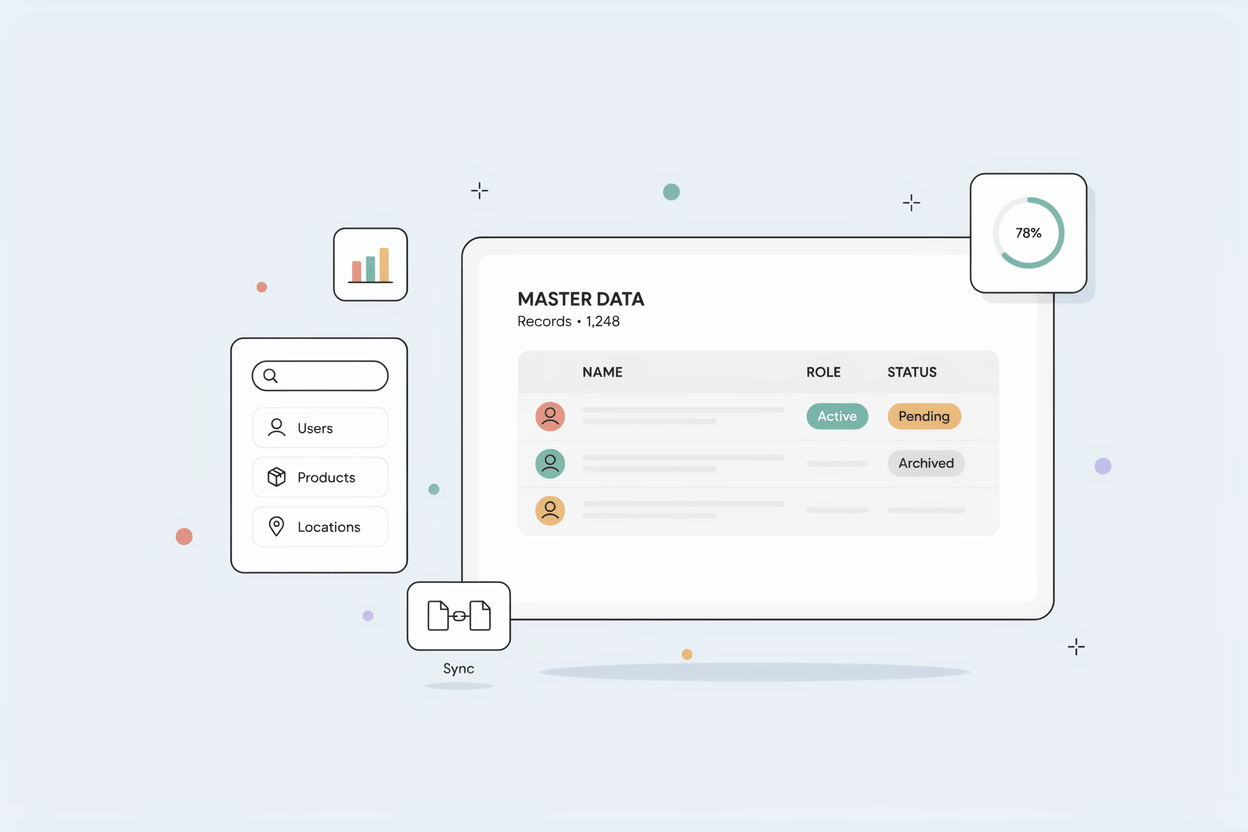
AtroCore takes the position that data quality governance has to be enforced at the data model level. Its master data management platform uses an EAV-based data model that lets organizations define which attributes are mandatory, which values are valid, and which changes require approval before they take effect. The result is a single source of truth for product, supplier, and other master data: trusted data that stays consistent across every connected system. Audit trails and bidirectional sync with ERPs and e-commerce platforms mean data quality controls follow the record across the full lifecycle, covering every system the data touches.
Where to Start
Start with the data entities causing the most downstream damage. For manufacturers and distributors, that is usually the product master or the supplier record. Map which attributes exist, who populates them, and what the current fill rates and accuracy rates look like. That audit will surface the three to five failures worth addressing first in your data quality governance effort.
Establish ownership for those specific attributes before buying any tooling. Write quality rules that are specific enough to be testable. "Product descriptions should be accurate" is not a rule. "Product descriptions must be between 100 and 500 characters, contain no HTML tags, and be populated for all active SKUs" is a rule. Reliable data follows from that kind of specificity. Nothing else produces it.
Data quality governance fails when organizations treat it as a project with a completion date. The companies that get it right treat it as an operational property of their data infrastructure, built into how data is created, moved, and changed, then sustained as an ongoing discipline.