


Key Takeaways
- Data synchronization keeps enterprise data consistent and accurate across all connected systems in real time or on a schedule.
- The main failure points are conflict resolution, latency, and schema mismatches between systems.
- Bidirectional, real-time synchronization is harder to implement correctly than most vendors suggest.
- The right architecture depends on data volume, update frequency, and the number of connected systems.
Most companies run at least a handful of systems side by side: an ERP, a CRM, an e-commerce platform, a PIM, a supplier portal. Each one holds data. Some of that data overlaps. And the moment the same record exists in two places, you have a synchronization problem.
Data synchronization is the process of keeping those records consistent and accurate across systems. A product price updated in the ERP should appear in the webshop. A customer address change in the CRM should be reflected in the billing system. When sync works, users in every system see the same truth. When it does not, you get order errors, compliance gaps, and decisions made on stale data. Gartner research puts the average annual cost of poor data quality at $12.9 million per organization (source: integrate.io). Data inconsistency across unsynchronized systems is one of the primary drivers of that figure.
What Synchronization Actually Does
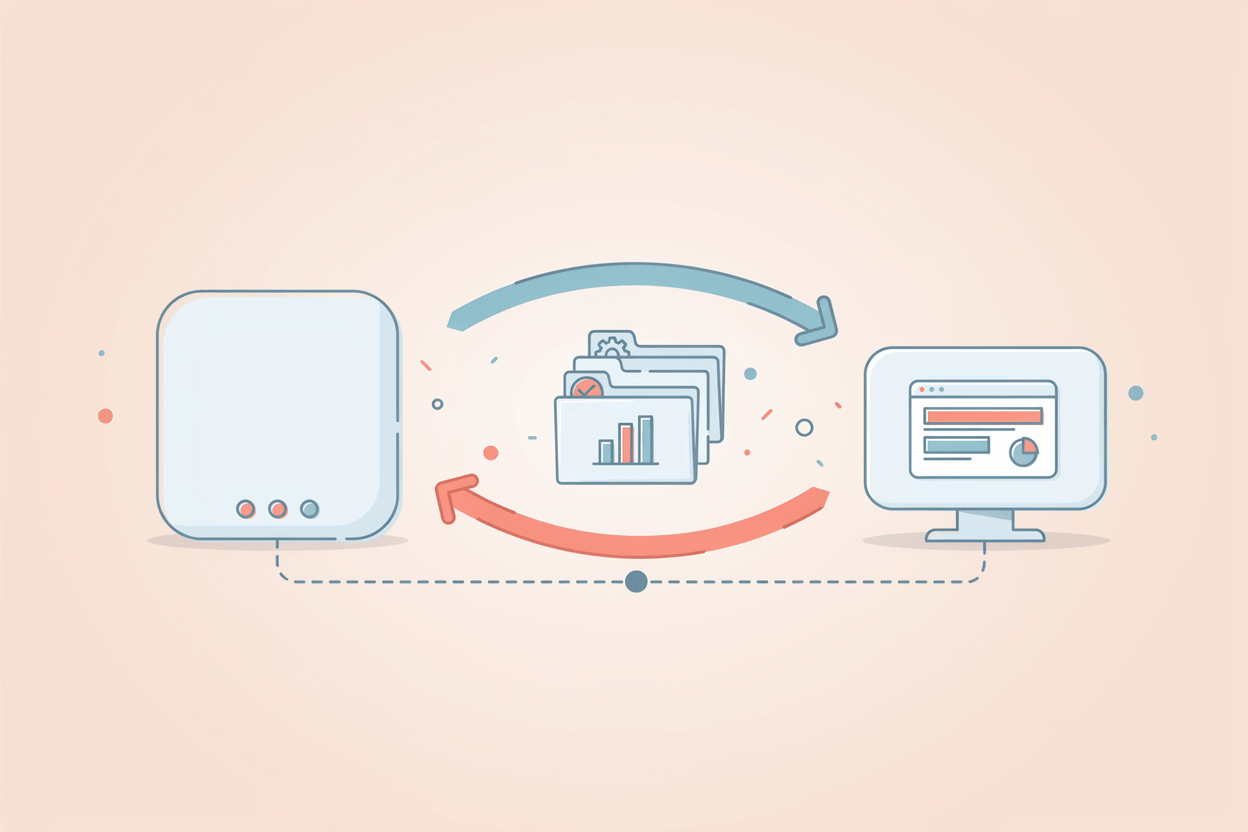
At its core, data synchronization detects a change in one system and propagates it to one or more others. The mechanics vary, but the goal is always the same: every connected system holds the same version of a record, maintaining data integrity across the entire data flow.
Two dimensions define any sync setup. The first is direction. One-way sync (unidirectional) pushes changes from a source to a target. The source is authoritative; the target only receives. Two-way sync (bidirectional) allows changes to flow in both directions, meaning either system can update a record, and the other must reflect it. Bidirectional sync is significantly more complex because changes can happen simultaneously in both systems, creating conflicts that require active conflict detection and resolution.
The second dimension is timing. Scheduled sync (also called batch sync) runs on a fixed interval: hourly, nightly, or weekly. It is simpler to implement and puts less load on systems, but the data is only as fresh as the last run. Continuous sync, or real-time synchronization, propagates changes as they happen, typically within seconds. Near real-time sync falls between the two: changes are buffered briefly before propagation, reducing infrastructure load while maintaining data consistency and keeping data exchange frequent. Most operational workflows require either continuous or near real-time data flow, but both demand more from the infrastructure than batch.
Real-time bidirectional sync between two or more enterprise systems is technically achievable. The challenge is not the sync itself. It is the conflict resolution logic that runs behind it.
How Sync Is Triggered
The method used to detect and transmit changes matters as much as direction or timing.
Change Data Capture (CDC)
CDC monitors a database's transaction log and captures every insert, update, and delete as it happens. Only changed records are transmitted in what is effectively an incremental sync: no full-dataset transfers, no redundant data replication of records that have not changed. It is common in high-volume environments where polling would create too much overhead, and it is the closest thing to true continuous sync at the database layer.
Polling and Scheduled Queries
Queries run against the source system at set intervals and compare results to a previous snapshot. Simpler to set up than CDC, but it introduces a lag equal to the polling interval. Any change that occurs and is then reversed between two polls is invisible to the target system. For most enterprise data, this means a periodic sync is adequate for slow-moving records but problematic for operational ones.
Event-Based Sync
The source system emits an event (a webhook, a message queue entry, an API call) when a record changes. The target listens and processes the event. This approach is low-latency and avoids full-dataset transfers, but requires both systems to support the same event model.
API-Based Sync
REST or other APIs push and pull data between systems on demand. Flexible and widely supported, but point-to-point API connections multiply quickly as the number of connected systems grows. A five-system landscape with direct API links between every pair requires ten separate integrations to maintain. iPaaS platforms and hub and spoke architectures exist specifically to address this scaling problem.
When Synchronization Breaks
Most data synchronization failures fall into a small number of categories.
Conflict resolution failures.
In two-way sync, the same record can be updated in both systems before either change has propagated. The most recent timestamp is the obvious tiebreaker, but timestamps across distributed systems are not always reliable. Without a clear conflict detection and resolution policy (last-write-wins, source-of-record hierarchy, or manual review queue), conflicts either silently overwrite valid data or block the sync entirely.
Data format mismatches.
System A stores a customer's full name in one field. System B splits it into first name and last name. System C adds a mandatory salutation field that System A does not have. Every structural difference requires a data transformation and mapping rule. When those rules are missing or outdated after a system upgrade, records fail to transfer or arrive malformed, undermining data accuracy and integrity throughout the pipeline.
Latency and ordering issues.
In event-based or real-time systems, events do not always arrive in the order they were created. An update event can arrive before the original create event. A delete can arrive before the associated update is processed. Systems that do not handle out-of-order events produce corrupted states and data loss.
Partial sync failures.
A sync job processing 10,000 records may fail at record 7,000. Without a checkpoint mechanism, some systems hold updated data while others do not. This creates data inconsistency that can be hard to detect and harder to repair, especially when downstream systems have already acted on the incomplete data.
Cascading updates.
In bidirectional sync, a change in System A triggers an update in System B, which triggers another sync back to System A. Without loop detection, this causes infinite update cycles that flood systems with redundant writes, a failure mode that point-to-point architectures are particularly prone to.
In projects we have implemented (connecting SAP or Oracle NetSuite to Shopify or supplier portals, for example), data format mismatches and missing conflict resolution logic account for the large majority of data synchronization problems. The initial setup appears to work. The failures surface weeks later, when edge cases hit production.
What Reliable Data Synchronization Architecture Needs
The architecture itself needs to handle the hard cases, including the edge cases that never appear in demos.
A single source of truth (or at minimum a clearly defined source-of-record per data entity) eliminates most conflict ambiguity. If the ERP is authoritative for pricing and the PIM is authoritative for product descriptions, conflict resolution follows from the hierarchy: the authoritative system wins for its domain. Most teams skip this step and build the sync first, then try to define data ownership later. That is when duplicate records and silent data conflicts start accumulating.
Data validation and transformation at the point of sync prevent malformed records from reaching target systems. Checks for required fields, value ranges, data format constraints, and referential integrity should run before a record is written, not after. This is where data governance enforcement happens in practice: deduplication, completeness checks, and business rules that apply uniformly across all connected systems. Without this layer, data quality management becomes a reactive cleanup task rather than a structural guarantee.
Replication logs and field-level audit trails make debugging possible. When a value arrives wrong, you need to trace which system sent it, when, and what the previous value was. Without logs, root-cause analysis becomes guesswork.
Retry and error handling logic ensures that a failed sync event does not disappear silently. Events should queue, retry with backoff, and surface for manual review when retries are exhausted.
AtroCore's integration platform handles data synchronization across ERP, e-commerce, CRM, and supplier systems as a central master data management hub. Rather than building point-to-point connectors between every system pair, each system exchanges data with one platform in a hub-and-spoke model. That architecture directly reduces cascading update risk and simplifies conflict detection: fewer direct system-to-system paths means fewer feedback loops. Built-in data transformation and validation address format mismatches at the point of sync, before records reach any target system. Configurable data mapping, deduplication, and field-level audit logging cover the remaining data governance requirements.
Batch vs. Real-Time: Choosing Based on Consequence
Real-time synchronization is necessary for operational data: inventory levels, order status,and pricing. But continuous sync puts sustained load on systems and requires solid error handling for every edge case. Scheduled sync is easier to operate and recover from, and it is often sufficient for data that changes infrequently: supplier records, product specifications, organizational hierarchies.
Many architectures use both. Real-time or near real-time data exchange for high-frequency, operationally critical records. Batch for bulk updates, historical loads, and master data management flows that do not drive live transactions.
The practical question is how quickly a stale value causes a real problem. For inventory shared between a webshop and a warehouse system, every minute counts. For a supplier's payment terms, they probably do not. Designing the data synchronization process around that question, rather than defaulting to continuous sync for everything, tends to produce architectures that are easier to operate and recover when something goes wrong.
Data synchronization failures are rarely caused by the protocol or the tool. They come from under-specified data ownership, missing validation, and sync logic that was never tested against edge cases. The engineering is in that layer, not in the choice of API format.