


Key Takeaways
- No single MDM tool fits every company. The right choice depends on your data domains, existing tech stack, and how much implementation overhead you can absorb.
- Enterprise platforms like Informatica and Semarchy cover the most ground but carry matching price tags and rollout timelines.
- Open-source MDM is a real option for mid-sized manufacturers and distributors, and a competitive one.
- For industrial companies, multi-domain support and ERP integration matter more than raw feature volume.
Master data management software is closer to infrastructure than software. The platform you choose will sit underneath every system that handles product, supplier, customer, or employee data. Most companies reaching this decision already have the same problem: data siloes built up over the years across ERP, CRM, e-commerce, and supplier portals, with no agreed-upon version of any record. A poor fit costs months of cleanup and rework.
This comparison groups the leading tools by what they're actually built for, so you can cut the vendors that don't match your situation before you start evaluating.
What to Look for Before You Compare
A few criteria matter more than the rest:
- Data domains covered: product, customer, supplier, employee, or all of the above
- Deployment model: cloud SaaS, on-premise, or hybrid
- Integration approach: REST API coverage, ERP connectors, real-time sync vs batch
- Data governance tools: workflow approvals, audit trails, role-based access
- Data stewardship: tools for business users to review, correct, and approve records
- Compliance coverage: GDPR, audit logging, access controls for regulated environments
- Total cost of ownership: licensing plus implementation plus ongoing IT overhead
The vendors below are evaluated against these criteria, not marketing claims.
MDM platforms also differ in how they manage the master record itself. Registry-style systems link records across source systems without moving data. Consolidation-style systems pull copies into a central hub for matching and deduplication. Coexistence-style systems maintain a central golden record and write it back to source systems in real time. Most modern platforms support more than one style, but the default architecture affects integration complexity and IT overhead significantly.
Best Enterprise MDM Platforms
Informatica MDM
Informatica covers customer, product, supplier, and reference data domains in a single platform, with AI-assisted matching, deduplication, and survivorship rules that produce a verified golden record for each entity. Gartner named Informatica a Leader in the 2026 Magic Quadrant for MDM Solutions for the seventh consecutive time, recognizing both Ability to Execute and Completeness of Vision.
The tradeoff is complexity. Deployments typically run six to eighteen months and require specialized consulting. Licensing is sized for global enterprises. A 500-person manufacturing operation will likely find it more than necessary.
Semarchy
Semarchy covers multiple data domains with solid governance tooling, built-in data stewardship workflows, and a shorter implementation timeline than Informatica. Business users get tools to review, correct, and approve records without IT involvement, and the platform runs on cloud, on-premise, or hybrid. Financial services and healthcare are its core markets, but any mid-to-large enterprise needing multi-domain MDM without a two-year rollout is a reasonable fit.
Reltio
Reltio is a cloud-native platform built around customer data and entity resolution across large record volumes. Organizations managing millions of customer records across multiple touchpoints are their primary audience. Recent releases have added AI-driven agent tooling for unstructured data enrichment.
Domain breadth is the limitation. Customer MDM is where Reltio is strongest. Product and supplier domains are less mature, which rules it out for manufacturers who need all three.
Best MDM Software for Manufacturers and Industrial Companies
Manufacturers, distributors, and industrial companies share a specific set of requirements: deep product data hierarchies, supplier master data, tight ERP integration, and legacy on-premise systems that aren't going anywhere soon.
Stibo Systems
Stibo Systems is built around product-heavy MDM. Coverage includes product, supplier, and location data with strong hierarchy management and classification tools. SAP, Oracle, and other major ERPs are supported. Stibo has a wide deployment in manufacturing and distribution.
Implementation is substantial, and the commercial model skews toward larger enterprises. For a manufacturer managing 50,000+ SKUs across multiple product families, Stibo is a credible choice.
AtroCore
AtroCore is an open-source MDM platform designed for mid-sized and large companies that need a flexible, ERP-ready data foundation. Product, supplier, customer, and employee data all live in a single unified hub. The EAV-based data model adapts to complex product structures without custom development.
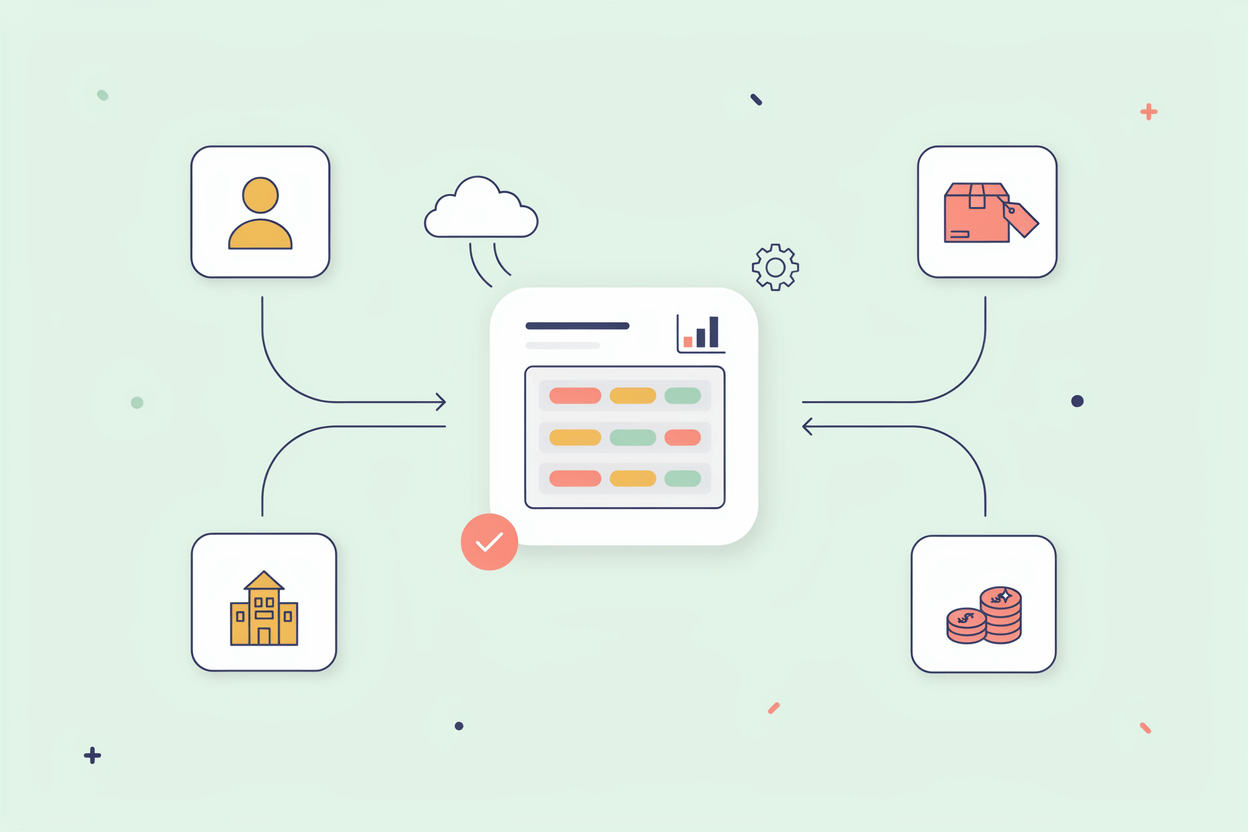
In projects we implemented for industrial equipment and building materials manufacturers, AtroCore consolidated multi-domain master data where clients had previously managed product and supplier records across three separate systems with no single source of truth, duplicate records across platforms, and no reliable deduplication process. The 100% REST API coverage made ERP integration clean without middleware, and bidirectional sync kept records current across connected platforms.
AtroCore runs on-premise or as SaaS. The GPLv3 license removes vendor lock-in. The modular architecture means companies can start with core MDM and add data governance, workflow, or DAM capabilities as the program grows.
Best Open-Source MDM Software
Open-source master data management software is often dismissed as a compromise. The better platforms deliver the same structural capabilities as enterprise tools, with full control over deployment and data.
AtroCore
AtroCore is the strongest open-source MDM option for B2B companies. The GPLv3 license and API-first architecture cover multi-domain master data management without the licensing overhead of enterprise SaaS. For manufacturers and distributors who need solid data governance and integration depth but aren't ready for a six-figure annual SaaS contract, it is a direct path to a functional MDM foundation.
The key difference from the manufacturers section above: AtroCore's value in pure open-source terms is the deployment flexibility. The same codebase runs on a private server, a cloud VM, or a managed SaaS instance. The company controls the data model, the schema, and the upgrade cadence.
Pimcore
Pimcore is an open-source platform combining PIM, DAM, MDM, CMS, and CDP in one codebase, with a large developer community and real flexibility for complex data modeling requirements.
The catch is implementation effort. Pimcore requires experienced PHP developers for customization. Business-user usability out of the box is limited compared to commercial SaaS tools. It works best for companies with internal development capacity that want deep technical control over their data infrastructure.
Best MDM for SAP and Oracle Environments
SAP Master Data Governance (MDG)
SAP MDG is the natural choice for SAP-heavy environments. Financial, material, supplier, and customer master data are covered, with native integration to SAP S/4HANA. Governance workflows, approval routing, and audit logging for GDPR and internal compliance are built in.
Outside the SAP ecosystem, it doesn't compete well on its own merits. Licensing ties to existing SAP agreements and implementation require SAP expertise. For a manufacturer already deep in SAP, that removes integration risk. For everyone else, it's the wrong starting point.
Oracle Enterprise Data Management
Oracle EDM follows the same logic. Inside Oracle Cloud and Oracle ERP environments, it handles global data hierarchies with solid scalability. Outside that ecosystem, the value proposition shrinks considerably.
Best MDM for Mid-Sized Companies
Mid-sized companies (roughly 200 to 2,000 employees) often need master data management software without the budget or IT capacity to absorb enterprise-scale implementations.
Profisee
Profisee is a mid-market MDM platform built on Azure, covering customer, product, and reference data. Deployment runs faster than enterprise-tier platforms. Azure Data Factory and Power BI integrations are built in, making it a natural fit for Microsoft-centric organizations.
Licensing is more accessible than Informatica or Semarchy, and the implementation timeline is shorter. For companies already invested in the Microsoft stack, it removes a layer of integration complexity.
AtroCore
For mid-sized manufacturers and distributors outside the Microsoft or SAP ecosystem, AtroCore is the most cost-effective path to a proper MDM foundation. The open-source model removes licensing costs. Deployment is flexible, and the platform scales as data volumes and complexity grow. Our customers typically run it as a central data hub connecting their ERP, e-commerce platform, and supplier portals through a single API layer.
How to Choose
| Use Case | Best Fit |
|---|---|
| Global enterprise, multiple domains | Informatica MDM |
| Multi-domain MDM, faster deployment | Semarchy |
| Customer MDM, large record volumes | Reltio |
| Product-heavy manufacturing/distribution | Stibo Systems, AtroCore |
| Open-source, full control | AtroCore, Pimcore |
| SAP-native environment | SAP MDG |
| Oracle-native environment | Oracle EDM |
| Mid-market, Microsoft stack | Profisee |
| Mid-market, flexible deployment | AtroCore |
Informatica, Semarchy, and AtroCore all claim multi-domain coverage across multiple deployment models. What separates them in practice is implementation complexity and total cost over three years, not the feature list on the product page.
For manufacturers and distributors managing product and supplier master data across multiple systems, map your integration requirements before evaluating platforms. ERP connector depth, API coverage, and sync approach will narrow the field faster than any other criterion.